
Globe-marked lady beetle
Azya orbigera

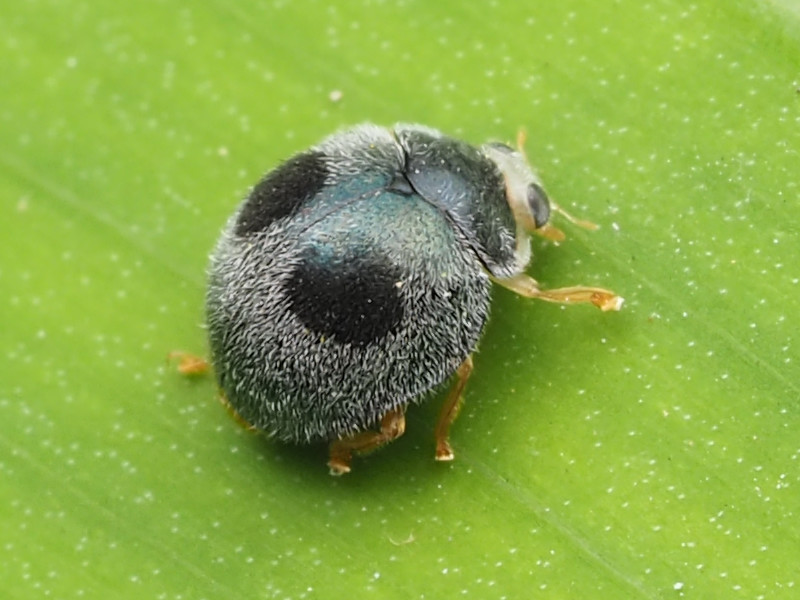
The globe-marked lady beetle is a tiny ladybird from the Americas. It has a yellow head and a dark greenish black back. On each wing cover sits one round spot, like a little globe.
Lives in
North and South America and islands in the Pacific, on plants in gardens and fields
Length
2.9 to 4.2 mm (0.11 to 0.17 in)
Can it hurt you?
Harmless
Harmless. It is a tiny ladybird that does not sting.
What does it eat?
Like most ladybirds, it hunts tiny soft insects that live on plants.
How big is it?
How long is it?
💅small enough to sit on your fingernail⚽could fly across a whole football pitch in 15 seconds⚡moves 1600 times its own body length every second
How big is Globe-marked lady beetle compared to YOU?
Just maths in your browser. Nothing is saved or sent anywhere.
How fast is it?
A kid running fast about 13 km/h (8.1 mph)
A grown-up on a bike about 25 km/h (16 mph)
Globe-marked lady beetle about 25 km/h (16 mph)
A car driving in town about 50 km/h (31 mph)
cool stuff
Fun facts
1
Grown-ups are only about 3 to 4 millimetres long.
2
Its head is yellow, but its back is so dark green that it looks almost black.
3
Scientists know two subspecies of it, and one of them is named after Ecuador.
you asked
Most asked questions about Globe-marked lady beetle
?How big is the globe-marked lady beetle?
Only about 3 to 4 millimetres long, smaller than many ladybirds you might know.
?Is the globe-marked lady beetle dangerous?
No. It is a harmless little ladybird.
For bug experts
- Scientific name
- Azya orbigera
- Named by
- Mulsant, 1850
- Group
- Ladybirds
- Family
- Coccinellidae
- Classification
- Insecta > Coleoptera > Coccinellidae
- Lives on
- North America, South America, Australia and Oceania
Where the facts come from
- Azya orbigera (Wikipedia, CC BY-SA 4.0): what it looks like, where it lives, what it eats, sizes and fun facts, retold in simple words.
- Picture by Zygy. CC0, Wikimedia Commons. The sticker of this bug is drawn from this picture.
If we got something wrong, sorry, we are bug fans, not a science journal. Tell us at [email protected] and we will fix it.
Bug Wiki honey jar For grown-ups: Bug Wiki is free, with no ads and no tracking. A small tip helps keep it online.Leave a tip Seven-spot ladybird
 Harlequin ladybird
 Mealybug destroyer
 Twenty-two-spot ladybird
 Twice-stabbed ladybird
 Spotted pink ladybird
 Green June beetle
 Western black widow
 Firebug
 Argentine ant
 Boll weevil
 Red admiral