
Granite ghost

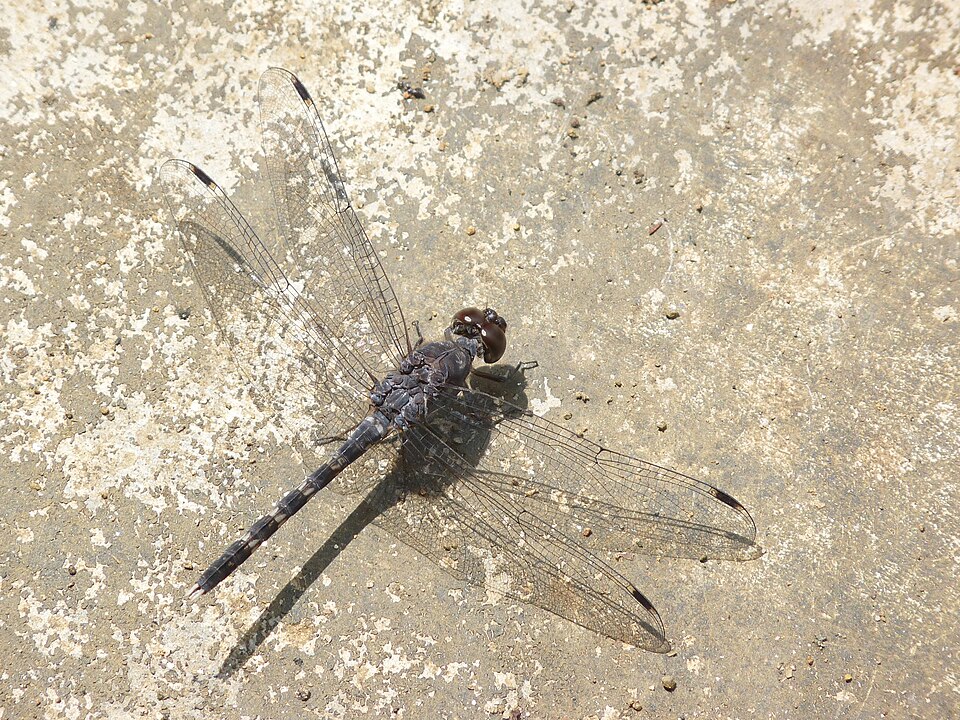
The granite ghost is a grey dragonfly speckled with black, just like a granite rock. When it rests flat on a rock or a cement wall, it almost disappears. That is why it is called a ghost.
How fast is it?
Fun facts
Its eyes are grey with a brown cap on top.
Each clear wing has a little spot that is black in the middle and white at both ends.
It lays its eggs in rainwater hollows in rocks, in wells and in small cement tanks.
Its larvae eat the larvae of the yellow fever mosquito, so it helps keep mosquitoes down.
Most asked questions about Granite ghost
?Why is it called the granite ghost?
Its grey speckled body looks like granite, and it almost vanishes when it rests on stone.
?Is the granite ghost helpful?
Yes. Its larvae eat the larvae of mosquitoes that spread disease.
For bug experts
- Scientific name
- Bradinopyga geminata
- Group
- Dragonflies and damselflies
- Family
- Libellulidae
- Classification
- Insecta > Odonata > Libellulidae
- Lives on
- Asia
Where the facts come from
- Bradinopyga geminata (Wikipedia, CC BY-SA 4.0): what it looks like, where it lives, what it eats, sizes and fun facts, retold in simple words.
- Picture by Jeevan Jose, Kerala, India. CC BY-SA 4.0, Wikimedia Commons. The sticker of this bug is drawn from this picture.
If we got something wrong, sorry, we are bug fans, not a science journal. Tell us at [email protected] and we will fix it.
Bug Wiki honey jar For grown-ups: Bug Wiki is free, with no ads and no tracking. A small tip helps keep it online.Leave a tip Emperor dragonfly
 Common whitetail
 Green darner
 Ebony jewelwing
 Globe skimmer
 Blue dasher
 Malaysian trumpet snail
 Raft spider
 Tansy beetle
 White-banded fishing spider
 Two-tailed swallowtail
 Striped fishing spider