
Greater thorn-tipped longhorn beetle
Pogonocherus hispidulus

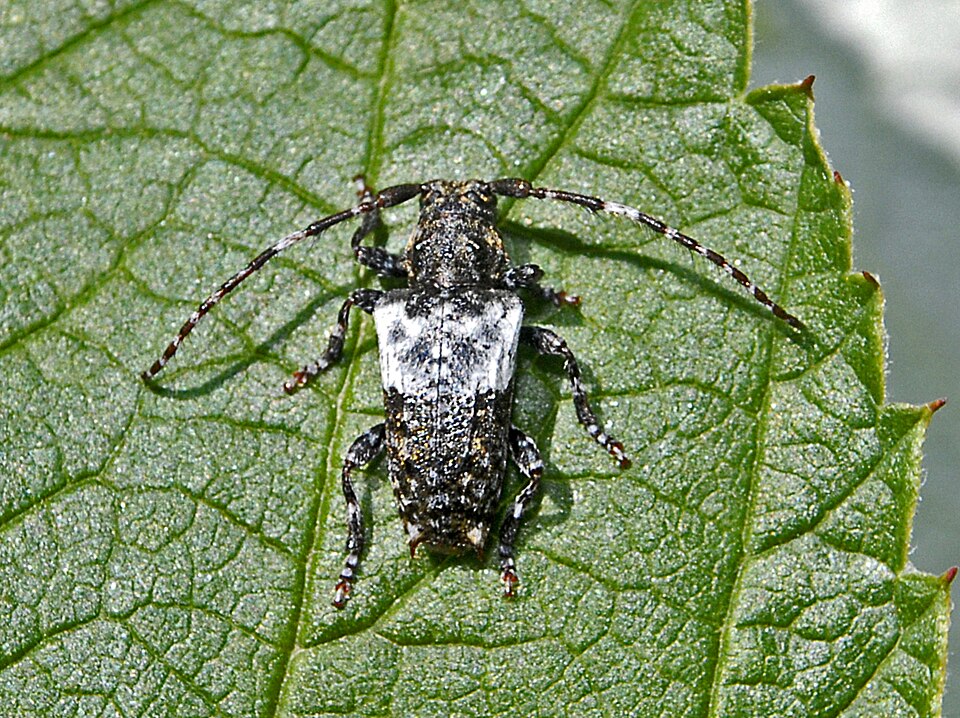
The greater thorn-tipped longhorn beetle is a small grey and black beetle with a wide whitish band across its back. Its long feelers have white rings. At the end of each wing cover it has a pointy little thorn.
Lives in
Most of Europe, the Caucasus, Russia, Turkey and the Near East, on trees and bushes
Length
5 to 8 mm (0.2 to 0.31 in)
Can it hurt you?
Harmless
Harmless. It is a small beetle that does not bite or sting people.
What does it eat?
Its babies live inside small dead branches and twigs of many kinds of trees and eat the wood.
How big is it?
How long is it?
💅small enough to sit on your fingernail🍽️could run across a dinner table in 16 seconds
How big is Greater thorn-tipped longhorn beetle compared to YOU?
Just maths in your browser. Nothing is saved or sent anywhere.
How fast is it?
A garden snail about 0.05 km/h (0.03 mph)
Greater thorn-tipped longhorn beetle about 0.23 km/h (0.14 mph)
A tortoise about 0.3 km/h (0.19 mph)
A person walking about 5 km/h (3.1 mph)
cool stuff
Fun facts
1
The little thorns on its wing covers give it its name.
2
Grown-up beetles can be seen from April until August.
3
Its babies are not picky and can grow in the twigs of many different leafy trees.
4
It usually takes two years for a baby to grow into a beetle.
you asked
Most asked questions about Greater thorn-tipped longhorn beetle
?Is the greater thorn-tipped longhorn beetle dangerous?
No. It is small and harmless to people.
?How big is the greater thorn-tipped longhorn beetle?
Small, only 5 to 8 mm long, but with long feelers.
For bug experts
- Scientific name
- Pogonocherus hispidulus
- Group
- Beetles
- Family
- Cerambycidae
- Classification
- Insecta > Coleoptera > Cerambycidae
- Lives on
- Europe, Asia
Where the facts come from
- Pogonocherus hispidulus (Wikipedia, CC BY-SA 4.0): what it looks like, where it lives, what it eats, sizes and fun facts, retold in simple words.
- Picture by Hectonichus. CC BY-SA 3.0, Wikimedia Commons. The sticker of this bug is drawn from this picture.
If we got something wrong, sorry, we are bug fans, not a science journal. Tell us at [email protected] and we will fix it.
Bug Wiki honey jar For grown-ups: Bug Wiki is free, with no ads and no tracking. A small tip helps keep it online.Leave a tip Stag beetle
 Hercules beetle
 Common glow-worm
 Goliath beetle
 Cockchafer
 Mealworm beetle
 Putnam's cicada
 Penitent underwing
 Tree termite
 Purple thorn
 Bad-wing moth
 Cola nut gall wasp