
Sulphur tubic
Esperia sulphurella

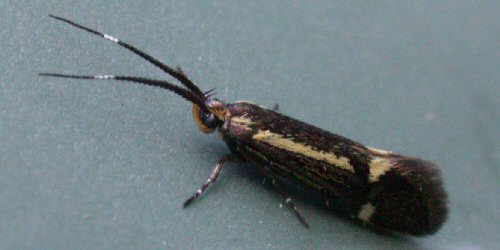
The sulphur tubic is a tiny dark brown moth with pale yellow markings. Its back wings are mostly pale yellow with dark tips. It flies in spring, and its black caterpillars live in dead wood.
Lives in
Europe, and California where people brought it
Length
6 to 8 mm (0.24 to 0.31 in)
Wingspan
1.2 to 1.6 cm (0.47 to 0.63 in)
Can it hurt you?
Harmless
Harmless. It cannot bite or sting.
What does it eat?
Its black caterpillars eat dead wood.
How big is it?
How long is it?
How wide are its wings?
💅small enough to sit on your fingernail⚽could fly across a whole football pitch in 42 seconds⚡moves 310 times its own body length every second
How big is Sulphur tubic compared to YOU?
Just maths in your browser. Nothing is saved or sent anywhere.
How fast is it?
A person walking about 5 km/h (3.1 mph)
Sulphur tubic about 8.9 km/h (5.5 mph)
A kid running fast about 13 km/h (8.1 mph)
A grown-up on a bike about 25 km/h (16 mph)
cool stuff
Fun facts
1
Each of its feelers has a little white band about two thirds of the way along.
2
It came from Europe, but now it also lives in California.
3
Later, scientists gave the same name to several other moths by mistake. Those names do not count any more.
you asked
Most asked questions about Sulphur tubic
?Is the sulphur tubic dangerous?
No. It is a tiny moth and cannot bite or sting.
?What do sulphur tubic caterpillars eat?
Dead wood. The caterpillars are black.
For bug experts
- Scientific name
- Esperia sulphurella
- Named by
- Fabricius, 1775
- Group
- Moths
- Family
- Oecophoridae
- Classification
- Insecta > Lepidoptera > Oecophoridae
- Lives on
- Europe, North America
Where the facts come from
- Esperia sulphurella (Wikipedia, CC BY-SA 4.0): what it looks like, where it lives, what it eats, sizes and fun facts, retold in simple words.
- Picture by No machine-readable author provided. Keith Edkins assumed (based on copyright claims).. CC BY-SA 3.0, Wikimedia Commons. The sticker of this bug is drawn from this picture.
If we got something wrong, sorry, we are bug fans, not a science journal. Tell us at [email protected] and we will fix it.
Bug Wiki honey jar For grown-ups: Bug Wiki is free, with no ads and no tracking. A small tip helps keep it online.Leave a tip Atlas moth
 Luna moth
 Hummingbird hawk-moth
 Domestic silk moth
 Isabella tiger moth
 Polyphemus moth
 Dotted paropsine leaf beetle
 Two-striped walkingstick
 Red-legged golden orb-weaver
 Aromatic cherry millipede
 Giant stag beetle
 Giant woodwasp