
African migrant
Catopsilia florella

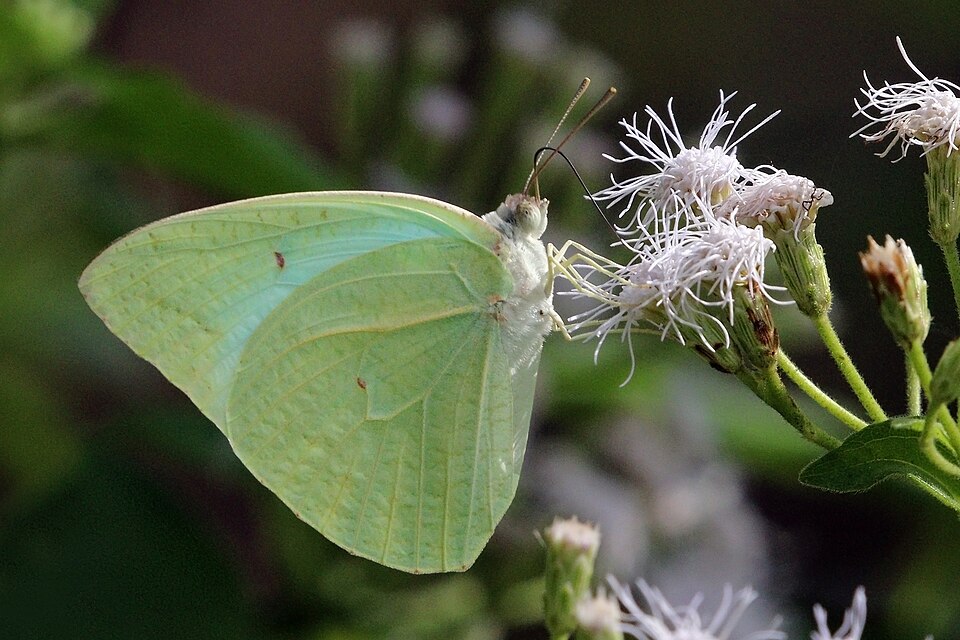
The African migrant is a pale butterfly that loves to travel. Every year large numbers fly away together from South Africa, heading north-east. You can see it flying in every month of the year.
Lives in
Africa, Madagascar, Arabia and the Canary Islands
Wingspan
5.4 to 6.6 cm (2.1 to 2.6 in)
Can it hurt you?
Harmless
Harmless. It cannot bite or sting.
What does it eat?
Grown-up butterflies sip nectar from flowers. Its caterpillars eat the leaves of senna and cassia plants.
How big is it?
How wide are its wings?
🧱wings as wide as 2 toy building bricks⚽could fly across a whole football pitch in 24 seconds
How big is African migrant compared to YOU?
Just maths in your browser. Nothing is saved or sent anywhere.
How fast is it?
A kid running fast about 13 km/h (8.1 mph)
African migrant about 16 km/h (9.9 mph)
A grown-up on a bike about 25 km/h (16 mph)
A car driving in town about 50 km/h (31 mph)
cool stuff
Fun facts
1
In South Africa it migrates from summer to autumn, always flying towards the north-east.
2
Females are a little bigger than males.
3
People once thought it also lived in Asia, but they were mixing it up with a look-alike butterfly.
you asked
Most asked questions about African migrant
?Why is it called the African migrant?
Because it migrates: big groups fly long distances together across Africa.
?What does the African migrant caterpillar eat?
Leaves of senna and cassia plants.
For bug experts
- Scientific name
- Catopsilia florella
- Group
- Butterflies
- Family
- Pieridae
- Classification
- Insecta > Lepidoptera > Pieridae
- Lives on
- Africa, Asia
- Also known as
- African emigrant, Common vagrant
Where the facts come from
- Catopsilia florella (Wikipedia, CC BY-SA 4.0): what it looks like, where it lives, what it eats, sizes and fun facts, retold in simple words.
- Picture by Charles J. Sharp. CC BY-SA 4.0, Wikimedia Commons. The sticker of this bug is drawn from this picture.
If we got something wrong, sorry, we are bug fans, not a science journal. Tell us at [email protected] and we will fix it.
Bug Wiki honey jar For grown-ups: Bug Wiki is free, with no ads and no tracking. A small tip helps keep it online.Leave a tip Monarch butterfly
 Peacock butterfly
 Blue morpho
 Old World swallowtail
 Small white
 Eastern tiger swallowtail
 Grove snail
 Tricoloured bumblebee
 Red milkweed beetle
 Purseweb spider
 Vampire moth
 Blue-banded bee
_male.jpg)