
Apple blossom beetle
Tropinota hirta

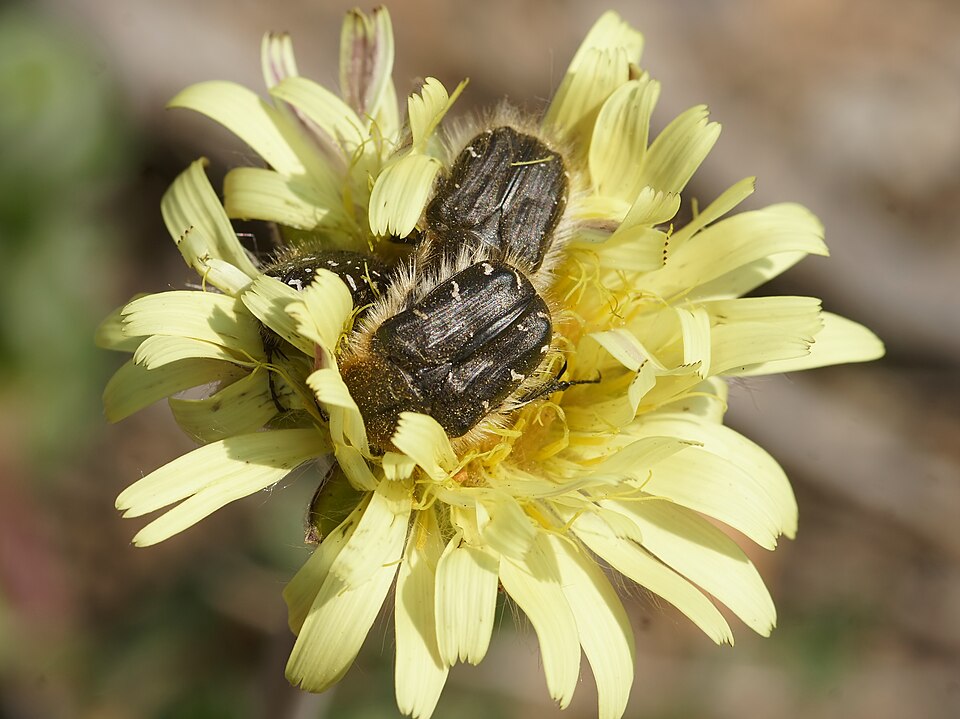
The apple blossom beetle is a black beetle with little white spots, covered in fuzzy hair. In spring it sits in flowers and eats parts of them. Its babies live hidden in the soil.
Lives in
Europe, northern Asia and around the Mediterranean Sea, on flowering plants
Can it hurt you?
Harmless
Harmless to people. It does not bite or sting, but it can damage flowers in gardens and orchards.
What does it eat?
The beetles eat parts of flowers, like petals and pollen, on many different plants. The larvae live in the soil and eat roots, mostly dead ones.
How fast is it?
A garden snail about 0.05 km/h (0.03 mph)
A tortoise about 0.3 km/h (0.19 mph)
Apple blossom beetle about 0.5 km/h (0.31 mph)
A person walking about 5 km/h (3.1 mph)
cool stuff
Fun facts
1
It comes out in April, just when lots of flowers start to bloom.
2
It is hairier than its look-alike, the Mediterranean spotted chafer, which is why it is called hirta, meaning hairy.
3
You do not find it in North or South America.
4
Its larvae in the soil do not hurt plants much, because they mostly eat dead roots.
you asked
Most asked questions about Apple blossom beetle
?Is the apple blossom beetle harmful?
Not to people. But it eats flowers and can harm fruit trees and garden flowers.
?What does the apple blossom beetle eat?
Parts of flowers. Its larvae eat roots in the soil.
For bug experts
- Scientific name
- Tropinota hirta
- Named by
- Poda, 1761
- Group
- Beetles
- Family
- Scarabaeidae
- Classification
- Insecta > Coleoptera > Scarabaeidae
- Lives on
- Europe, Asia, Africa
- Also known as
- Hairy rose beetle
Where the facts come from
- Tropinota hirta (Wikipedia, CC BY-SA 4.0): what it looks like, where it lives, what it eats, sizes and fun facts, retold in simple words.
- Picture by Hans Hillewaert. CC BY-SA 4.0, Wikimedia Commons. The sticker of this bug is drawn from this picture.
If we got something wrong, sorry, we are bug fans, not a science journal. Tell us at [email protected] and we will fix it.
Bug Wiki honey jar For grown-ups: Bug Wiki is free, with no ads and no tracking. A small tip helps keep it online.Leave a tip Stag beetle
 Hercules beetle
 Common glow-worm
 Goliath beetle
 Cockchafer
 Mealworm beetle
 Red cabbage bug
 Western sheep moth
 Indian red admiral
 Southern paper wasp
 Rocky Mountain parnassian
 Sandalwood defoliator