
Cattail toothpick grasshopper

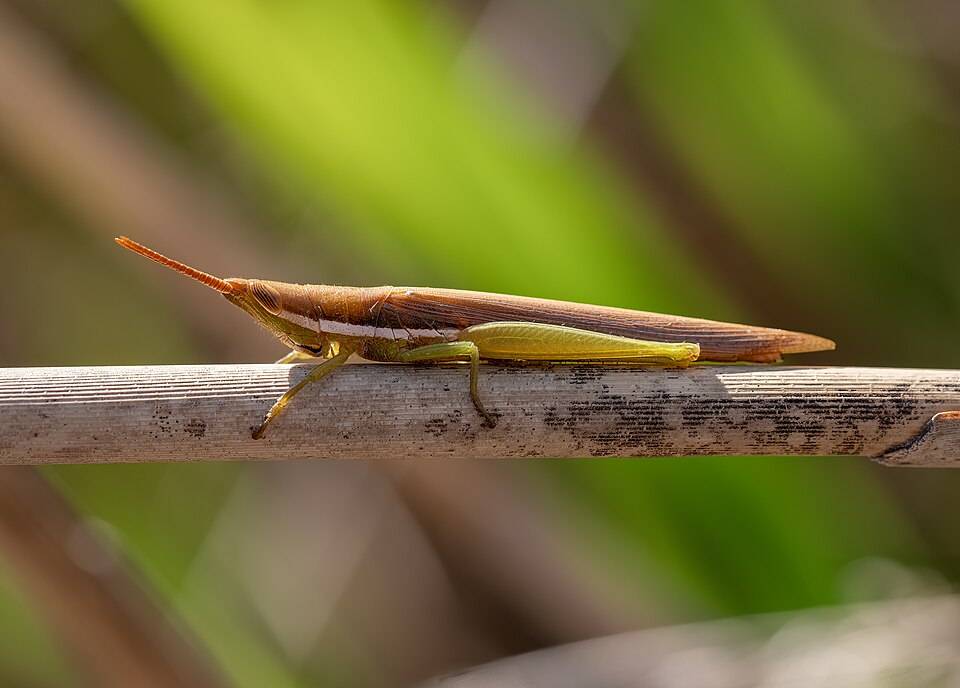
The cattail toothpick grasshopper is a long, thin grasshopper with a very pointed head and flat, sword shaped feelers. It is usually brown with a pale stripe from its eye down to its front legs. It sits on cattails and sedges in wet places.
How fast is it?
Fun facts
Its front wings are sharply pointed and stick out 3 to 5 millimetres past the end of its body.
Its head is as long as, or even longer than, the part of the body right behind it.
The female lays her eggs inside the stem of a plant.
It has a little spine between its front legs, which helps tell it apart from look-alike grasshoppers.
Most asked questions about Cattail toothpick grasshopper
?Where does the cattail toothpick grasshopper live?
In wet places across the United States, Mexico, the Caribbean and the warm parts of the Americas, on plants like cattails.
?Where does the cattail toothpick grasshopper lay its eggs?
The female lays her eggs inside the stem of a plant. The mating season begins around April.
For bug experts
- Scientific name
- Leptysma marginicollis
- Group
- Grasshoppers and crickets
- Family
- Acrididae
- Classification
- Insecta > Orthoptera > Acrididae
- Lives on
- North America, South America
- Also known as
- Slender locust
Where the facts come from
- Leptysma marginicollis (Wikipedia, CC BY-SA 4.0): what it looks like, where it lives, what it eats, sizes and fun facts, retold in simple words.
- Picture by Rhododendrites. CC BY-SA 4.0, Wikimedia Commons. The sticker of this bug is drawn from this picture.
If we got something wrong, sorry, we are bug fans, not a science journal. Tell us at [email protected] and we will fix it.
Bug Wiki honey jar For grown-ups: Bug Wiki is free, with no ads and no tracking. A small tip helps keep it online.Leave a tip Desert locust
 House cricket
 Parktown prawn
 Eastern lubber grasshopper
 Australian plague locust
 Mormon cricket
 Scarlet tiger moth
 Tansy beetle
 Beautiful demoiselle
 Great pond snail
 Broad-bodied chaser
 Golden-ringed dragonfly
.jpg)