
Changeable mantleslug
Megapallifera mutabilis
Name means: “named for its mantle, the cloak of skin that covers its whole back”

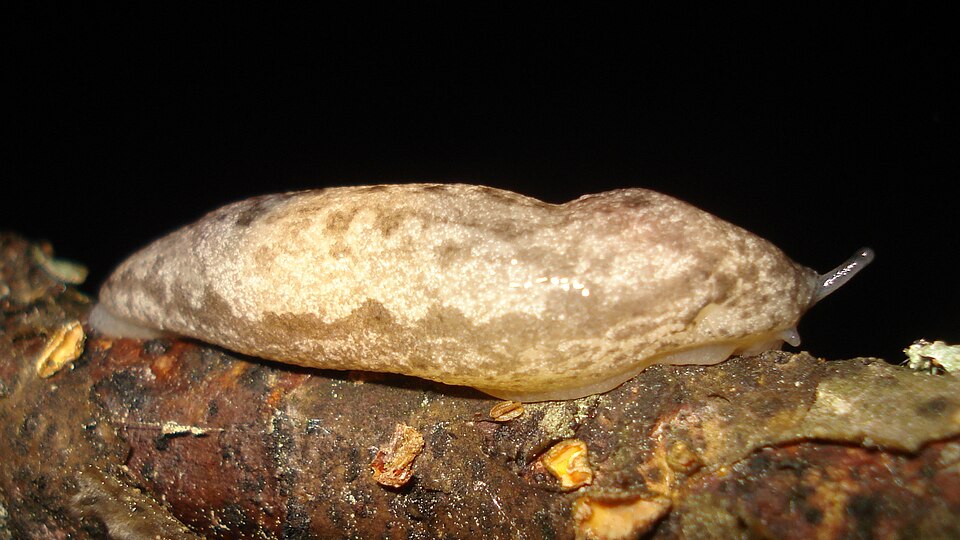
The changeable mantleslug is a soft slug that loves to climb trees. A cloak of skin covers its whole back, like a raincoat. It shares cosy, wet holes in trees with its slug friends.
Fun fact: this one is not an insect at all, it has no legs! But kids find it on every bug hunt, so it lives in Bug Wiki too.
Lives in
Eastern North America, in leafy forests
Can it hurt you?
Harmless
Harmless. Wash your hands after touching a slug, like after touching any wild animal.
What does it eat?
It mostly eats algae, the tiny green plant-like growth that covers tree bark.
How fast is it?
Changeable mantleslug about 0.02 km/h (0.01 mph)
A garden snail about 0.05 km/h (0.03 mph)
A tortoise about 0.3 km/h (0.19 mph)
A person walking about 5 km/h (3.1 mph)
cool stuff
Fun facts
1
It often lives up in living trees, such as beech trees.
2
Two to five slugs huddle together in a tree hole filled with water, and up to 12 can share one hole.
3
After a trip to find food it dips its tail in the water to drink and get wet again.
4
It lives for about one year, and the next slugs move into the same old tree holes.
you asked
Most asked questions about Changeable mantleslug
?Where does the changeable mantleslug live?
In leafy forests in eastern North America, from Canada down to the Gulf of Mexico.
?What does the changeable mantleslug eat?
Mostly algae, the green growth on tree bark.
For bug experts
- Scientific name
- Megapallifera mutabilis
- Group
- Snails, slugs and worms
- Family
- Philomycidae
- Classification
- Gastropoda > Stylommatophora > Philomycidae
- Lives on
- North America
Where the facts come from
- Megapallifera mutabilis (Wikipedia, CC BY-SA 4.0): what it looks like, where it lives, what it eats, sizes and fun facts, retold in simple words.
- Picture by Paul J. Morris. CC BY-SA 2.0, Wikimedia Commons. The sticker of this bug is drawn from this picture.
If we got something wrong, sorry, we are bug fans, not a science journal. Tell us at [email protected] and we will fix it.
Bug Wiki honey jar For grown-ups: Bug Wiki is free, with no ads and no tracking. A small tip helps keep it online.Leave a tip Garden snail
 Giant African land snail
 Leopard slug
 Bladder snail
 Medicinal leech
 Common earthworm
 Degeer's thickjaw
 Orange mapwing
 Cape docile scorpion
 Dark-spotted palthis moth
 Queen of the huntsmen
 Scarlet Jezebel