
Citrus cicada
Diceroprocta apache

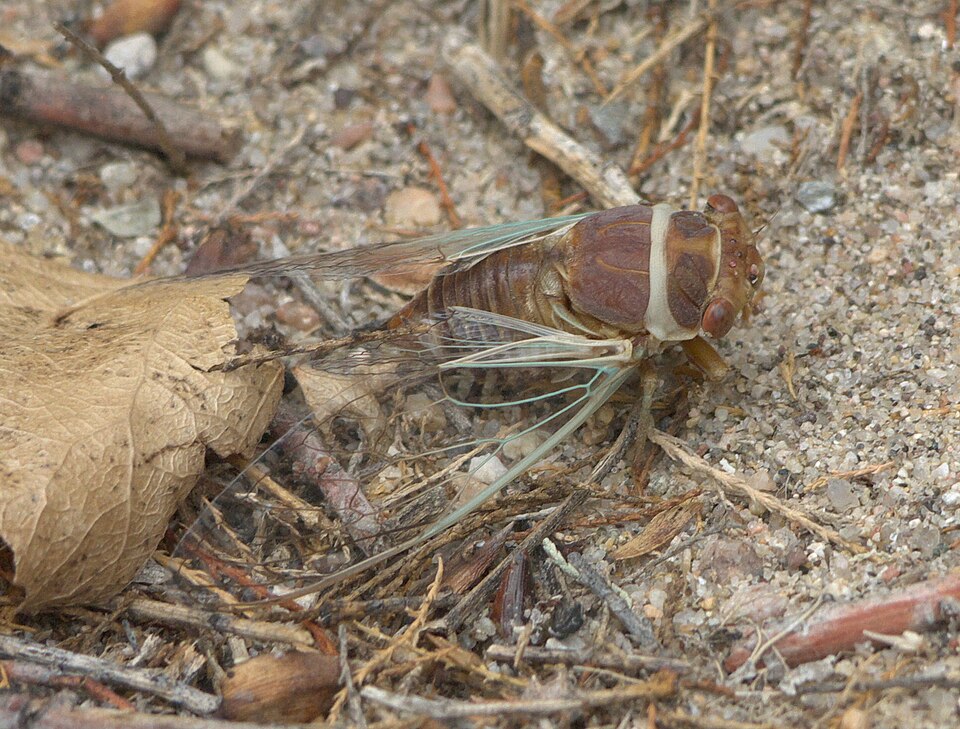
The citrus cicada is a cicada from the hot southwest of North America. Cicadas are the insects famous for their loud buzzing songs in summer. This one lives in deserts, near rivers and streams.
Lives in
Southwestern North America, near rivers in desert areas
Can it hurt you?
Harmless
Harmless. Cicadas do not sting and are not dangerous.
What does it eat?
Like other cicadas, it sucks the juice, called sap, out of plants with its beak-like mouth.
How fast is it?
A person walking about 5 km/h (3.1 mph)
Citrus cicada about 12 km/h (7.5 mph)
A kid running fast about 13 km/h (8.1 mph)
A grown-up on a bike about 25 km/h (16 mph)
cool stuff
Fun facts
1
From egg to the end of its life, it usually lives three to four years.
2
Like all cicadas, it spends its young life underground and only climbs out to become a winged adult.
3
It is an important part of desert river life, because many other animals depend on it.
you asked
Most asked questions about Citrus cicada
?How long does the citrus cicada live?
Usually about three to four years from egg to the end of its life.
?Is the citrus cicada dangerous?
No. Cicadas do not sting and are harmless to people.
For bug experts
- Scientific name
- Diceroprocta apache
- Group
- True bugs and cicadas
- Family
- Cicadidae
- Classification
- Insecta > Hemiptera > Cicadidae
- Lives on
- North America
- Also known as
- Apache cicada
Where the facts come from
- Diceroprocta apache (Wikipedia, CC BY-SA 4.0): what it looks like, where it lives, what it eats, sizes and fun facts, retold in simple words.
- Picture by xpda. CC BY-SA 4.0, Wikimedia Commons. The sticker of this bug is drawn from this picture.
If we got something wrong, sorry, we are bug fans, not a science journal. Tell us at [email protected] and we will fix it.
Bug Wiki honey jar For grown-ups: Bug Wiki is free, with no ads and no tracking. A small tip helps keep it online.Leave a tip Pharaoh cicada
 Spotted lanternfly
 Brown marmorated stink bug
 Cochineal
 Boxelder bug
 Western conifer seed bug
 Bolivian salmon pink tarantula
 Empress Leilia
 Indomitable graphic moth
 The hermit
 Great sooty satyr
 Red-backed darkling beetle