
Cliveden snail

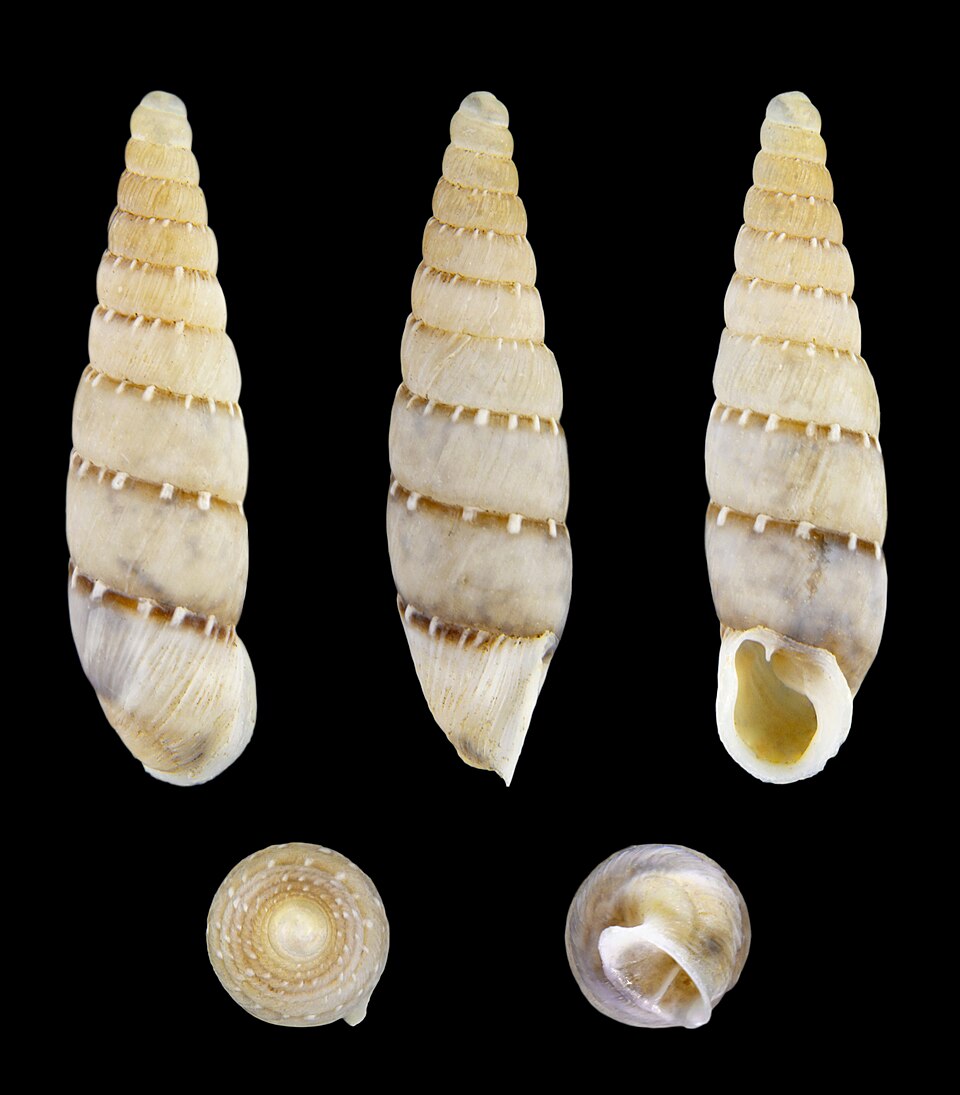
The Cliveden snail is a tiny snail with a tall, thin shell, like a little tower. Its shell has small white bumps along the lines where it winds round. It loves old stone walls and has travelled to new countries hidden in blocks of stone.
How big is it?
How long is it?
How big is Cliveden snail compared to YOU?
Just maths in your browser. Nothing is saved or sent anywhere.
How fast is it?
Fun facts
In 2004 people found a small group of these snails living on an old stone railing in the gardens of Cliveden House in England. That is how it got its name.
The stone railing was brought from a park in Rome in 1896. The snails had come along with it and lived there for over 100 years before anyone noticed.
Its shell is about 12 to 15 millimetres tall and winds round 10 or 11 times. It also turns to the left, which most snail shells do not.
It belongs to the door snails, which have a tiny door inside the shell to close it.
In 2009 some of these snails travelled to Germany on blocks of Italian stone and survived a whole winter in a stonemason's yard.
Most asked questions about Cliveden snail
?Why is it called the Cliveden snail?
Because in England it was found living at a big old house called Cliveden, on a stone railing that came from Italy.
?How big is the Cliveden snail?
Tiny. Its shell is only about 3 to 4 millimetres wide and 12 to 15 millimetres tall.
For bug experts
- Scientific name
- Papillifera papillaris
- Named by
- Müller, 1774
- Group
- Snails, slugs and worms
- Family
- Clausiliidae
- Classification
- Gastropoda > Stylommatophora > Clausiliidae
- Lives on
- Europe, Africa, Asia
Where the facts come from
- Papillifera papillaris (Wikipedia, CC BY-SA 4.0): what it looks like, where it lives, what it eats, sizes and fun facts, retold in simple words.
- Picture by H. Zell. CC BY-SA 3.0, Wikimedia Commons. The sticker of this bug is drawn from this picture.
If we got something wrong, sorry, we are bug fans, not a science journal. Tell us at [email protected] and we will fix it.
Bug Wiki honey jar For grown-ups: Bug Wiki is free, with no ads and no tracking. A small tip helps keep it online.Leave a tip Garden snail
 Giant African land snail
 Leopard slug
 Bladder snail
 Medicinal leech
 Common earthworm
 Small salmon Arab
 Grand antlion
 Spotted sulphur
 Inflated beetle
 Bolivian salmon pink tarantula
 Empress Leilia