
Dingy dusk-darter
Zyxomma petiolatum
Name means: “joined eyes and a little stalk, after its big touching eyes and its very thin waist”

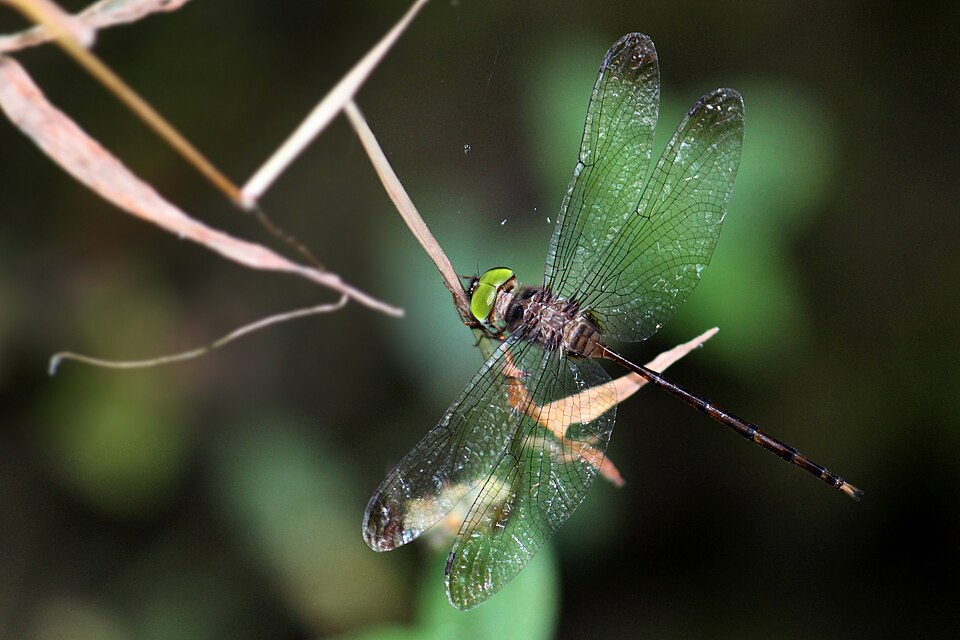
The dingy dusk-darter is a chocolate brown dragonfly with big emerald green eyes. It wakes up when the sun goes down. In the evening it zooms low over the water and snaps up midges and mosquitoes.
Lives in
Many parts of Asia, New Guinea, northern Australia and Pacific islands, near ponds and swamps
Can it hurt you?
Harmless
Harmless. Dragonflies have no sting, and this one even eats mosquitoes.
What does it eat?
It hunts midges and mosquitoes over the water. Its babies live under water and hunt there.
How fast is it?
A kid running fast about 13 km/h (8.1 mph)
A grown-up on a bike about 25 km/h (16 mph)
Dingy dusk-darter about 40 km/h (25 mph)
A car driving in town about 50 km/h (31 mph)
cool stuff
Fun facts
1
It is most active at dusk, but it also flies on cloudy days.
2
It is an extremely fast flyer.
3
In the daytime it rests among plants and is hard to find.
4
It lays its eggs in small pools, ponds, swamps and slow rivers.
5
Its tail has a very thin part near the body, which gave it its scientific name.
you asked
Most asked questions about Dingy dusk-darter
?When can you see the dingy dusk-darter?
Mostly in the evening, flying low over water. In the day it hides in plants.
?What does the dingy dusk-darter eat?
Midges and mosquitoes that it catches while flying.
For bug experts
- Scientific name
- Zyxomma petiolatum
- Group
- Dragonflies and damselflies
- Family
- Libellulidae
- Classification
- Insecta > Odonata > Libellulidae
- Lives on
- Asia, Australia and Oceania
- Also known as
- Long-tailed duskdarter, Brown dusk hawk, Dingy duskflyer
Where the facts come from
- Zyxomma petiolatum (Wikipedia, CC BY-SA 4.0): what it looks like, where it lives, what it eats, sizes and fun facts, retold in simple words.
- Picture by Rison Thumboor from Thrissur, India. CC BY 2.0, Wikimedia Commons. The sticker of this bug is drawn from this picture.
If we got something wrong, sorry, we are bug fans, not a science journal. Tell us at [email protected] and we will fix it.
Bug Wiki honey jar For grown-ups: Bug Wiki is free, with no ads and no tracking. A small tip helps keep it online.Leave a tip Emperor dragonfly
 Common whitetail
 Green darner
 Ebony jewelwing
 Globe skimmer
 Blue dasher
 Blue long-horned snailkiller
 Broad-winged skipper
 Hairy-horned springtail-hunter
 Small red sedge
 Willow apple gall sawfly
 Chevrolat's dytiscid
_(25368467958).jpg)