
Four-striped digger bee
Amegilla quadrifasciata

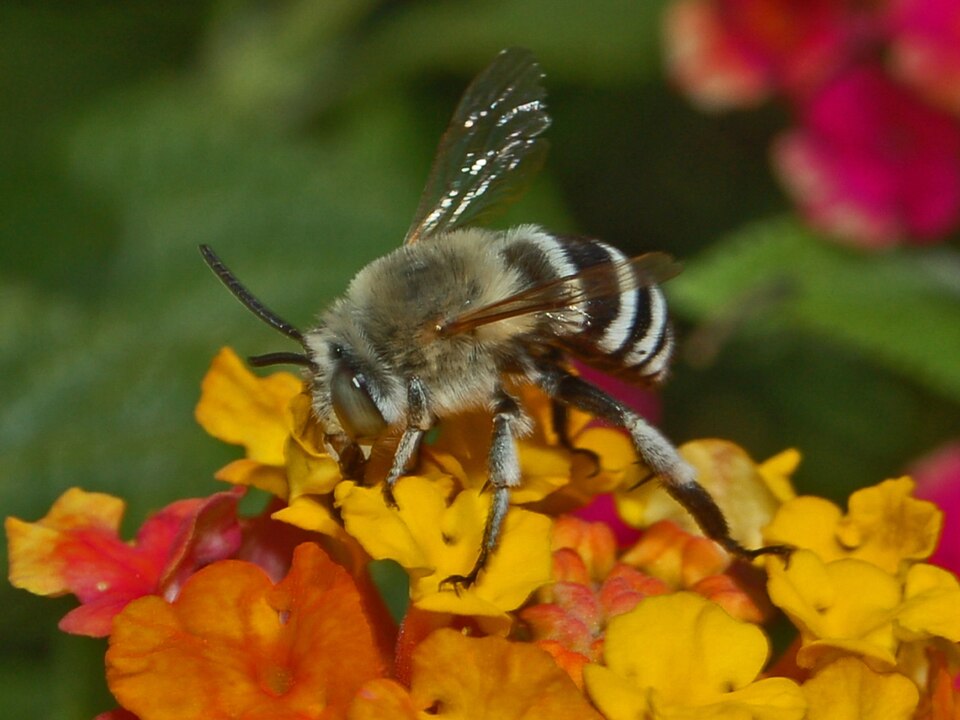
The four-striped digger bee is a fuzzy bee with an orange-brown hairy chest. Its tummy has black and white stripes. It has very big eyes and a long tongue for sipping nectar.
Lives in
From the Canary Islands across southern Europe and North Africa to central Asia and Japan
Length
0.9 to 1.2 cm (0.35 to 0.47 in)
What does it eat?
It drinks nectar and collects pollen from flowers like alfalfa, sage and basil. Its babies eat pollen and nectar stored by their mother.
How big is it?
How long is it?
🍚as long as 2 grains of rice in a row⚽could fly across a whole football pitch in 17 seconds⚡moves 510 times its own body length every second
How big is Four-striped digger bee compared to YOU?
Just maths in your browser. Nothing is saved or sent anywhere.
How fast is it?
A kid running fast about 13 km/h (8.1 mph)
Four-striped digger bee about 22 km/h (14 mph)
A grown-up on a bike about 25 km/h (16 mph)
A car driving in town about 50 km/h (31 mph)
cool stuff
Fun facts
1
It lives alone, not in a big hive. Each mother looks after her own babies.
2
The mother digs tunnels in loose soil for her nest.
3
Its long tongue lets it reach nectar deep inside flowers.
4
Its babies stay underground all winter and come out as bees in March.
you asked
Most asked questions about Four-striped digger bee
?Where does the four-striped digger bee make its nest?
In tunnels it digs in loose soil.
For bug experts
- Scientific name
- Amegilla quadrifasciata
- Group
- Bees and bumblebees
- Family
- Apidae
- Classification
- Insecta > Hymenoptera > Apidae
- Lives on
- Europe, Africa, Asia
- Also known as
- White-banded digger bee
Where the facts come from
- Amegilla quadrifasciata (Wikipedia, CC BY-SA 4.0): what it looks like, where it lives, what it eats, sizes and fun facts, retold in simple words.
- Picture by Hectonichus. CC BY-SA 3.0, Wikimedia Commons. The sticker of this bug is drawn from this picture.
If we got something wrong, sorry, we are bug fans, not a science journal. Tell us at [email protected] and we will fix it.
Bug Wiki honey jar For grown-ups: Bug Wiki is free, with no ads and no tracking. A small tip helps keep it online.Leave a tip Western honey bee
 Buff-tailed bumblebee
 Violet carpenter bee
 Giant honey bee
 Wallace's giant bee
 Himalayan giant honey bee
 Little snipefly
 Locust leafminer
 Grey-spotted sedgesitter
 Black-bordered lemon moth
 Indian flower chafer
 Sycamore seed bug