
Garden march fly
Bibio hortulanus

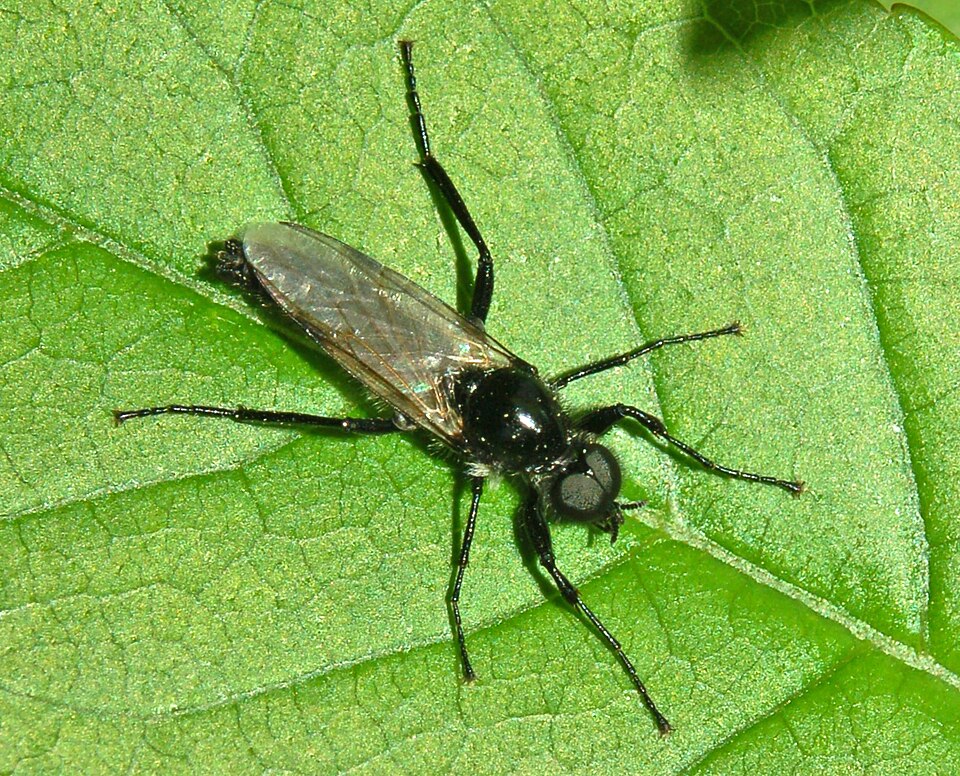
The garden march fly is a hairy fly that shows up in spring. The males are all black with huge eyes that touch in the middle. The females look very different, with an orange-red back.
Lives in
Most of Europe, North Africa and the Middle East, in meadows, hedges and woodland edges
Length
6.5 to 8.5 mm (0.26 to 0.33 in)
Can it hurt you?
Harmless
Harmless. It cannot bite or sting.
What does it eat?
The grown-ups feed on flowers like cow parsley and wild carrot. The larvae live in the soil and eat rotting plant bits and grass roots.
How big is it?
How long is it?
💅small enough to sit on your fingernail⚽could fly across a whole football pitch in 46 seconds⚡moves 270 times its own body length every second
How big is Garden march fly compared to YOU?
Just maths in your browser. Nothing is saved or sent anywhere.
How fast is it?
A person walking about 5 km/h (3.1 mph)
Garden march fly about 8.2 km/h (5.1 mph)
A kid running fast about 13 km/h (8.1 mph)
A grown-up on a bike about 25 km/h (16 mph)
cool stuff
Fun facts
1
You can see the grown-up flies from the middle of March to the middle of June.
2
The females have much smaller eyes than the males, set far apart.
3
Its larvae live in the soil. The older ones nibble grass roots and can harm clover and grain crops.
4
It looks a lot like a close cousin, but that one has red thighs.
you asked
Most asked questions about Garden march fly
?Is the garden march fly dangerous?
No. It cannot bite or sting.
?When can you see garden march flies?
From the middle of March to the middle of June.
For bug experts
- Scientific name
- Bibio hortulanus
- Group
- Flies and mosquitoes
- Family
- Bibionidae
- Classification
- Insecta > Diptera > Bibionidae
- Lives on
- Europe, Africa, Asia
- Also known as
- Marchfly
Where the facts come from
- Bibio hortulanus (Wikipedia, CC BY-SA 4.0): what it looks like, where it lives, what it eats, sizes and fun facts, retold in simple words.
- Picture by Hectonichus. CC BY-SA 4.0, Wikimedia Commons. The sticker of this bug is drawn from this picture.
If we got something wrong, sorry, we are bug fans, not a science journal. Tell us at [email protected] and we will fix it.
Bug Wiki honey jar For grown-ups: Bug Wiki is free, with no ads and no tracking. A small tip helps keep it online.Leave a tip Housefly
 New World screwworm fly
 Lovebug
 Tsetse fly
 Common fruit fly
 Asian tiger mosquito
 Algerian jumping spider
 Eastern gemmed-satyr
 Streaked lady beetle
 Graceful-legs lynx
 Yellow-spotted webworm moth
 Garden bembidion beetle
-001.JPG)