
Giant jumping ant

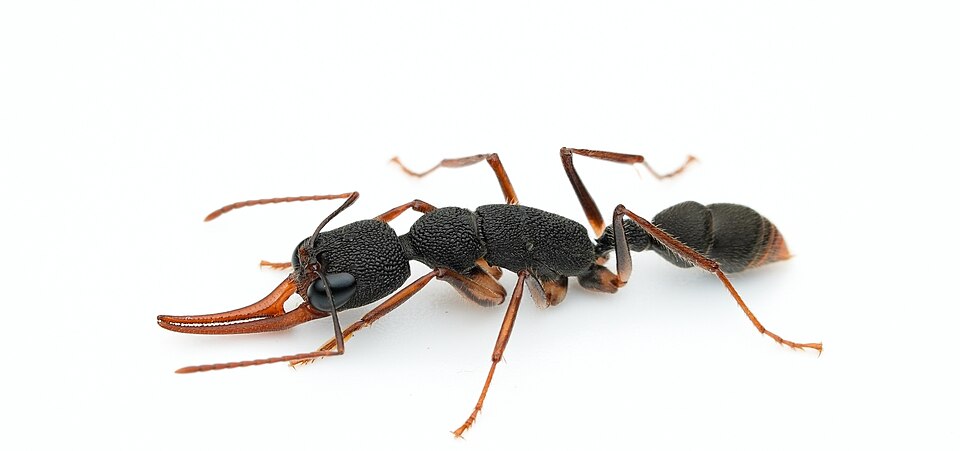
The giant jumping ant is a black ant from the forests of India and Burma, with brownish yellow legs and a rusty tip on its tail end. It can jump to catch its prey. Its jaws are like a clever tool kit that can grip hard or hold an egg very gently.
How fast is it?
Fun facts
Its jaws have two rows of teeth near the tip for a strong grip, and a smooth hollow near the base for carrying eggs gently.
Its jaws can turn in two different directions, which helps it do many different jobs.
Its nests are small, with only about 8 to 70 ants.
The rooms of the nest are joined by a narrow tunnel that is just wide enough for one ant to squeeze through.
Worker ants lay special eggs that are not for hatching, but are food for the queen and other ants.
Most asked questions about Giant jumping ant
?Can giant jumping ants really jump?
Yes. They jump to catch their prey.
?Where do giant jumping ants live?
In shady forests in northern India and Burma.
?How big is a giant jumping ant nest?
Small. Only about 8 to 70 ants live together.
For bug experts
- Scientific name
- Harpegnathos venator
- Group
- Ants
- Family
- Formicidae
- Classification
- Insecta > Hymenoptera > Formicidae
- Lives on
- Asia
Where the facts come from
- Harpegnathos venator (Wikipedia, CC BY-SA 4.0): what it looks like, where it lives, what it eats, sizes and fun facts, retold in simple words.
- Picture by Jonghyun Park. CC BY 4.0, Wikimedia Commons. The sticker of this bug is drawn from this picture.
If we got something wrong, sorry, we are bug fans, not a science journal. Tell us at [email protected] and we will fix it.
Bug Wiki honey jar For grown-ups: Bug Wiki is free, with no ads and no tracking. A small tip helps keep it online.Leave a tip Black garden ant
 Bullet ant
 Pharaoh ant
 Argentine ant
 Red imported fire ant
 Yellow crazy ant
 White-lip globe snail
 Cousinly bumble bee
 Yosemite millipede
 Silver-banded hairstreak
 Hornet beetle
 Tobacco-coloured longhorn beetle
.jpg)