
Giant South American snail
Megalobulimus oblongus

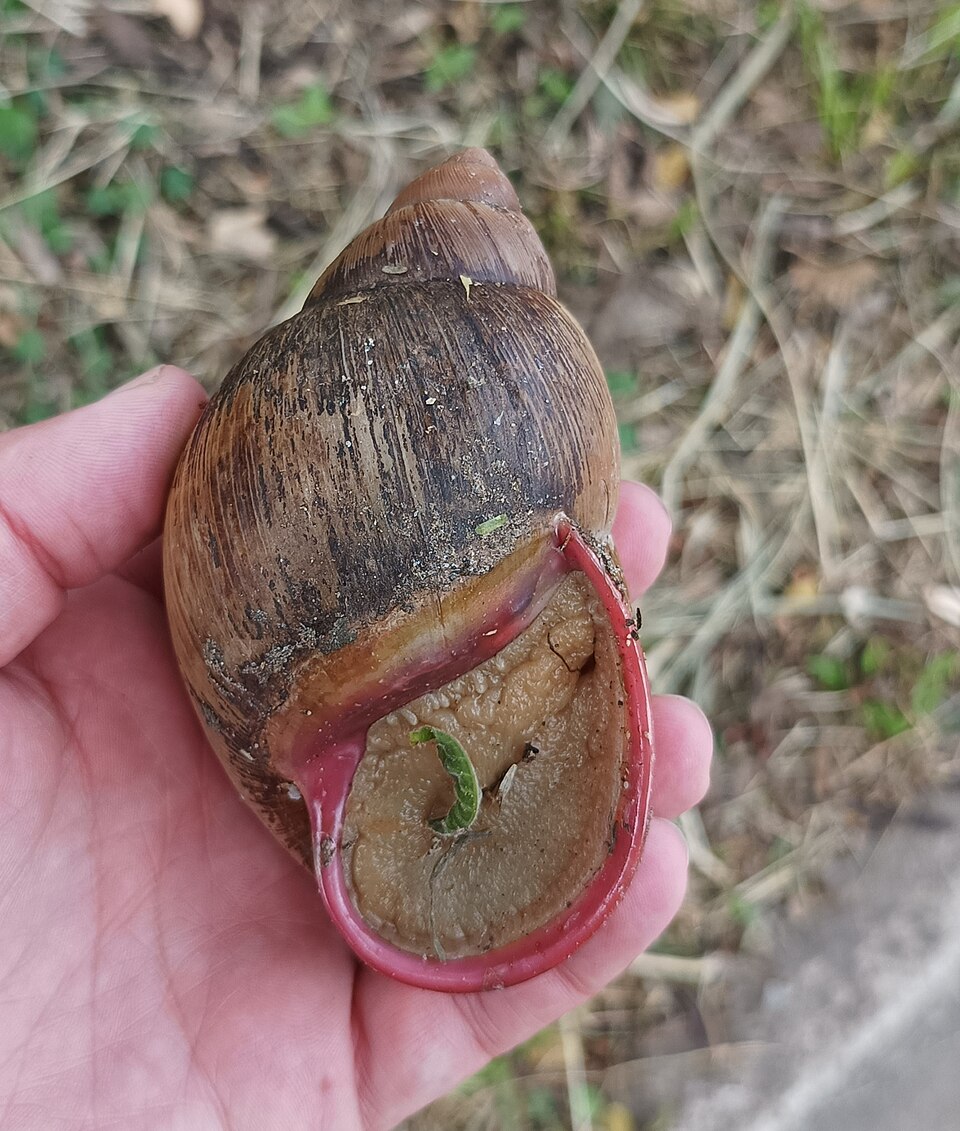
The giant South American snail is a land snail from warm parts of South America and the Caribbean. It carries its shell on its back and breathes air. In Venezuela people call it the guácara.
Fun fact: this one is not an insect at all, it has no legs! But kids find it on every bug hunt, so it lives in Bug Wiki too.
Lives in
South America and the Caribbean, from Brazil and Peru to Barbados and Trinidad
Can it hurt you?
Harmless
Harmless. Wash your hands after touching a snail, like after touching any wild animal.
What does it eat?
Like most land snails, it nibbles on plants with a rough tongue.
How fast is it?
Giant South American snail about 0.03 km/h (0.02 mph)
A garden snail about 0.05 km/h (0.03 mph)
A tortoise about 0.3 km/h (0.19 mph)
A person walking about 5 km/h (3.1 mph)
cool stuff
Fun facts
1
In Venezuela it has its own name: the guácara.
2
It lives in many countries, from Uruguay and Brazil all the way to small Caribbean islands like Barbados.
3
It is a land snail with a lung, so it breathes air instead of water.
you asked
Most asked questions about Giant South American snail
?Where does the giant South American snail live?
In South America and on Caribbean islands such as Barbados and Trinidad.
?Is the giant South American snail dangerous?
No. It is a harmless snail, but wash your hands after touching it.
For bug experts
- Scientific name
- Megalobulimus oblongus
- Group
- Snails, slugs and worms
- Family
- Strophocheilidae
- Classification
- Gastropoda > Stylommatophora > Strophocheilidae
- Lives on
- South America, North America
Where the facts come from
- Megalobulimus oblongus (Wikipedia, CC BY-SA 4.0): what it looks like, where it lives, what it eats, sizes and fun facts, retold in simple words.
- Picture by ajott. CC BY 4.0, Wikimedia Commons. The sticker of this bug is drawn from this picture.
If we got something wrong, sorry, we are bug fans, not a science journal. Tell us at [email protected] and we will fix it.
Bug Wiki honey jar For grown-ups: Bug Wiki is free, with no ads and no tracking. A small tip helps keep it online.Leave a tip Garden snail
 Giant African land snail
 Leopard slug
 Bladder snail
 Medicinal leech
 Common earthworm
 Pacific beetle cockroach
 Postman butterfly
 Bumblebee millipede
 Jungle nymph
 Giant pill millipede
 Fringed ornamental tarantula