
Household casebearer

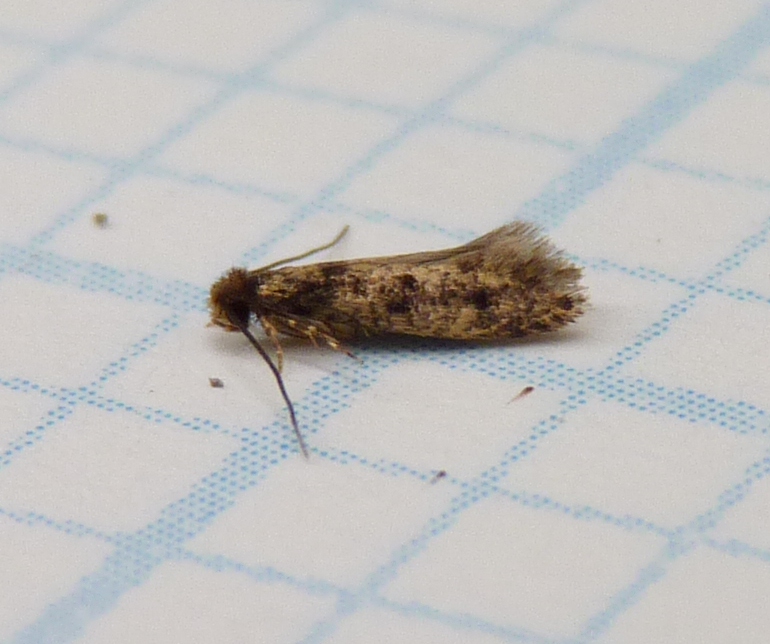
The household casebearer is a tiny grey moth with dark spots. Its caterpillar is famous: it builds a little sleeping bag out of silk, covered with dust, sand and tiny bits of dirt, and drags it everywhere. The case looks like a flat pumpkin seed on the wall.
How big is it?
How wide are its wings?
How big is Household casebearer compared to YOU?
Just maths in your browser. Nothing is saved or sent anywhere.
How fast is it?
Fun facts
Its case has an opening at each end, and the caterpillar can turn around inside to poke its head out of either one.
When the caterpillar is fully grown, its case is about 14 millimetres long, twice as long as the caterpillar.
The caterpillar turns into a moth inside its case.
A female can lay up to 200 tiny pale blue eggs.
Most asked questions about Household casebearer
?What are the little cases on my wall?
They may be household casebearer caterpillars, which carry a case made of silk and dust.
?Is the household casebearer harmful?
It is harmless to people, but it can eat wool, so it can be a small pest at home.
For bug experts
- Scientific name
- Phereoeca uterella
- Group
- Moths
- Family
- Tineidae
- Classification
- Insecta > Lepidoptera > Tineidae
- Lives on
- South America, North America
- Also known as
- Plaster bagworm
Where the facts come from
- Phereoeca uterella (Wikipedia, CC BY-SA 4.0): what it looks like, where it lives, what it eats, sizes and fun facts, retold in simple words.
- Picture by Dendroica cerulea. CC BY 2.0, Wikimedia Commons. The sticker of this bug is drawn from this picture.
If we got something wrong, sorry, we are bug fans, not a science journal. Tell us at [email protected] and we will fix it.
Bug Wiki honey jar For grown-ups: Bug Wiki is free, with no ads and no tracking. A small tip helps keep it online.Leave a tip Atlas moth
 Luna moth
 Hummingbird hawk-moth
 Domestic silk moth
 Isabella tiger moth
 Polyphemus moth
 Grey house spider
 Australian hornet
 European cave spider
 Immigrant pavement ant
 Giant house spider
 Cardinal spider