
Introduced pine sawfly
Diprion similis

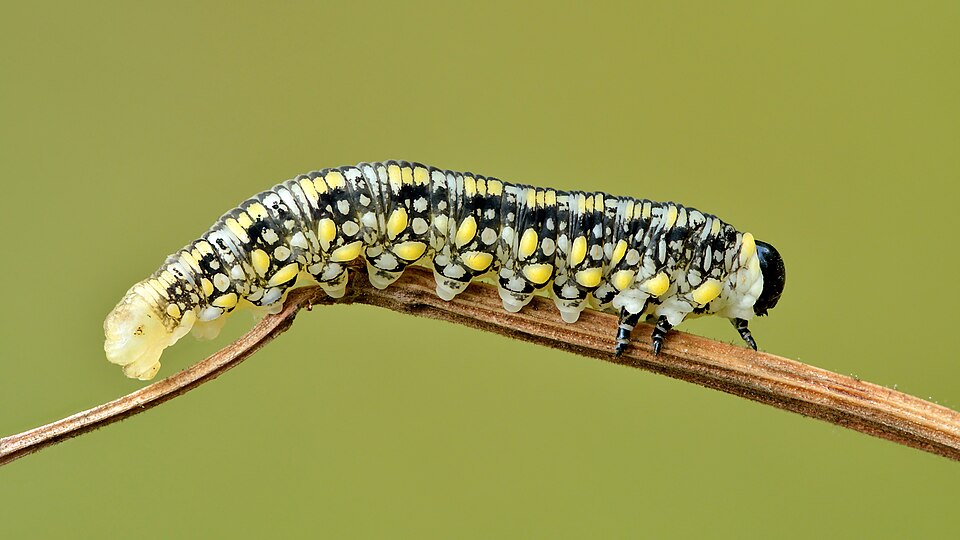
Its babies look a lot like caterpillars and munch on pine needles. It came from Europe and Asia and travelled by accident to North America.
Lives in
Central and northern Europe and Asia, and now eastern North America, in pine forests
Length
0.7 to 1 cm (0.28 to 0.39 in)
What does it eat?
Its larvae eat pine needles, and they like the white pine best of all.
How big is it?
How long is it?
💅small enough to sit on your fingernail🍚as long as 1.5 grains of rice in a row⚽could fly across a whole football pitch in 22 seconds⚡moves 470 times its own body length every second
How big is Introduced pine sawfly compared to YOU?
Just maths in your browser. Nothing is saved or sent anywhere.
How fast is it?
A kid running fast about 13 km/h (8.1 mph)
Introduced pine sawfly about 17 km/h (11 mph)
A grown-up on a bike about 25 km/h (16 mph)
A car driving in town about 50 km/h (31 mph)
cool stuff
Fun facts
1
The mother cuts a little slit in a pine needle and lays about ten eggs inside it.
2
Males have feathery feelers, while females have feelers with tiny teeth like a saw.
3
It was first found in North America in 1914, in Connecticut, and then spread far.
4
Some larvae sleep in their cocoon for up to three years before they grow up.
you asked
Most asked questions about Introduced pine sawfly
?What does the pine sawfly eat?
Its larvae eat pine needles, most of all from white pines.
For bug experts
- Scientific name
- Diprion similis
- Group
- Wasps and hornets
- Family
- Diprionidae
- Classification
- Insecta > Hymenoptera > Diprionidae
- Lives on
- Europe, Asia, North America
- Also known as
- Imported pine sawfly, White pine sawfly
Where the facts come from
- Diprion similis (Wikipedia, CC BY-SA 4.0): what it looks like, where it lives, what it eats, sizes and fun facts, retold in simple words.
- Picture by Ivar Leidus. CC BY-SA 4.0, Wikimedia Commons. The sticker of this bug is drawn from this picture.
If we got something wrong, sorry, we are bug fans, not a science journal. Tell us at [email protected] and we will fix it.
Bug Wiki honey jar For grown-ups: Bug Wiki is free, with no ads and no tracking. A small tip helps keep it online.Leave a tip European hornet
 Northern giant hornet
 Bald-faced hornet
 Red velvet ant
 Eastern cicada killer
 Asian hornet
 Red-necked footman
 Orange-patched smoky moth
 Black-winged subterranean termite
 Blood-red longhorn beetle
 Diana treebrown
 Black-shouldered drone fly
.jpg)