
Japanese leafhopper
Orientus ishidae

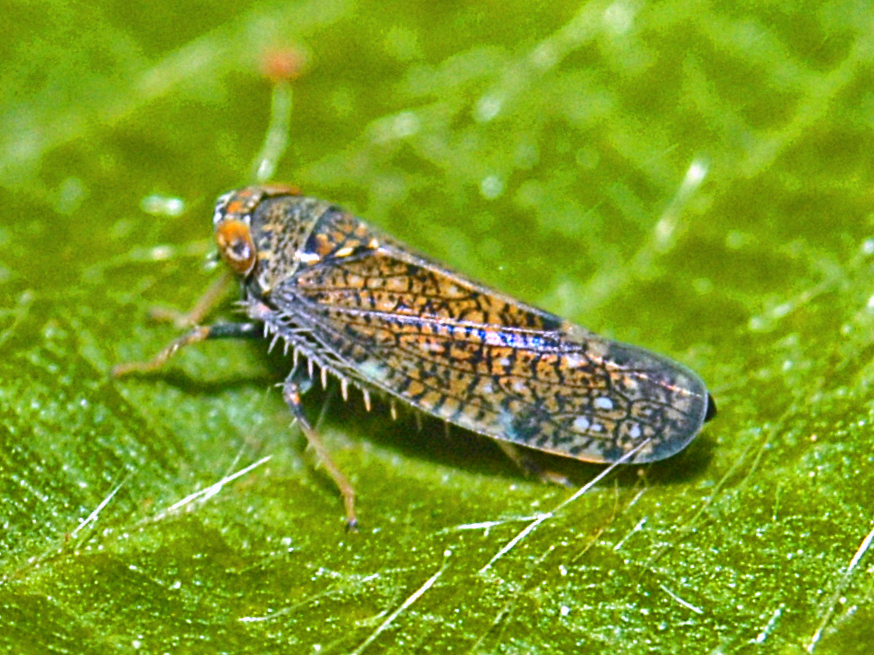
The Japanese leafhopper is a tiny jumping bug. Its front wings have a pattern like a mosaic made of little tiles. It has an orange band between its eyes.
Lives in
East Asia, and it has spread to North America and many European countries
Length
4.5 to 6.5 mm (0.18 to 0.26 in)
Can it hurt you?
Harmless
Harmless to people. It can harm trees and spread a disease in grapevines.
What does it eat?
It sucks sap from willow, hornbeam and many other trees and woody plants.
How big is it?
How long is it?
💅small enough to sit on your fingernail🍽️could run across a dinner table in 4 seconds⚡moves 38 times its own body length every second
How big is Japanese leafhopper compared to YOU?
Just maths in your browser. Nothing is saved or sent anywhere.
How fast is it?
A tortoise about 0.3 km/h (0.19 mph)
Japanese leafhopper about 0.9 km/h (0.56 mph)
A person walking about 5 km/h (3.1 mph)
A kid running fast about 13 km/h (8.1 mph)
cool stuff
Fun facts
1
When its babies feel danger, they lift their tails up in the air.
2
Its babies are brightly coloured, and no two look exactly alike.
3
It was first found in the United Kingdom in 2011, in London.
4
You can see the grown-ups from June to October.
you asked
Most asked questions about Japanese leafhopper
?Is the Japanese leafhopper harmful?
Not to people, but it can damage tree leaves and spread a disease in vineyards.
?How big is the Japanese leafhopper?
It is tiny, only about half a centimetre long.
For bug experts
- Scientific name
- Orientus ishidae
- Group
- True bugs and cicadas
- Family
- Cicadellidae
- Classification
- Insecta > Hemiptera > Cicadellidae
- Lives on
- Asia, North America, Europe
- Also known as
- Mosaic leafhopper
Where the facts come from
- Orientus ishidae (Wikipedia, CC BY-SA 4.0): what it looks like, where it lives, what it eats, sizes and fun facts, retold in simple words.
- Picture by Hectonichus. CC BY-SA 3.0, Wikimedia Commons. The sticker of this bug is drawn from this picture.
If we got something wrong, sorry, we are bug fans, not a science journal. Tell us at [email protected] and we will fix it.
Bug Wiki honey jar For grown-ups: Bug Wiki is free, with no ads and no tracking. A small tip helps keep it online.Leave a tip Pharaoh cicada
 Spotted lanternfly
 Brown marmorated stink bug
 Cochineal
 Boxelder bug
 Western conifer seed bug
 Box tree moth
 Carolina mantis
 Garden tiger moth
 Hummingbird clearwing
 Giant swallowtail
 Great green bush-cricket