
Large thistle weevil
Cleonis pigra

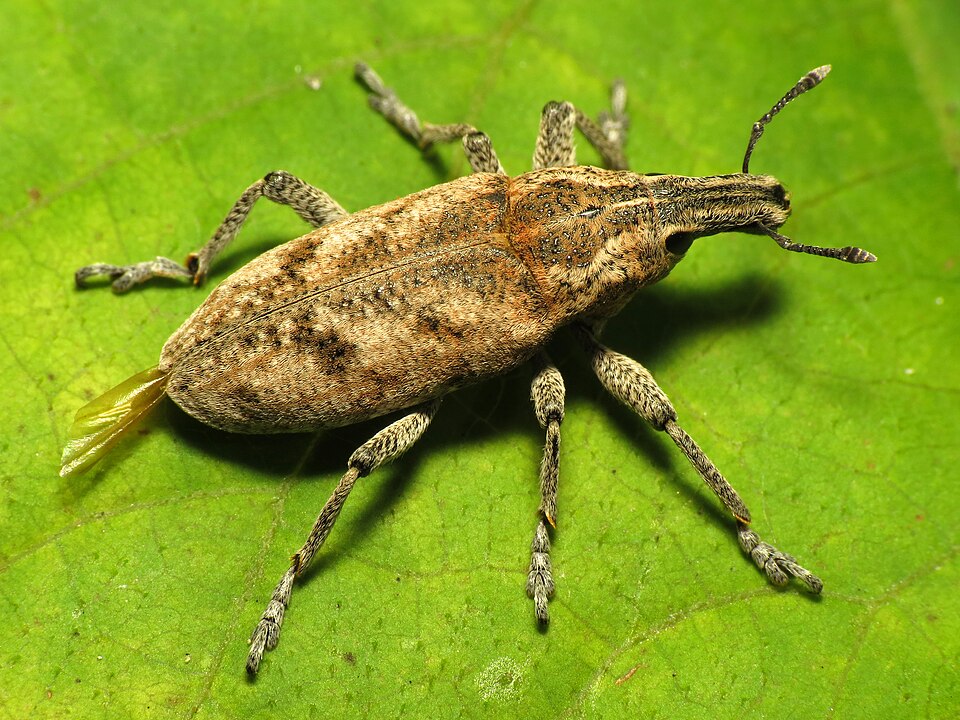
The large thistle weevil is a beetle with a long nose called a snout. It has a double V pattern on its wing cases. People even took it to North America so it could help get rid of a weed called creeping thistle.
Lives in
Europe and Asia, and brought to North America
Can it hurt you?
Harmless
Harmless. It cannot bite or sting people.
What does it eat?
Its young grow up inside the roots of thistles and other daisy family plants.
How fast is it?
A garden snail about 0.05 km/h (0.03 mph)
Large thistle weevil about 0.1 km/h (0.06 mph)
A tortoise about 0.3 km/h (0.19 mph)
A person walking about 5 km/h (3.1 mph)
cool stuff
Fun facts
1
Its babies grow inside plant roots.
2
Another name for it is the sluggish weevil.
3
Scientists have spelled its name in several different ways, which caused a lot of mix-ups.
you asked
Most asked questions about Large thistle weevil
?Why was the large thistle weevil brought to North America?
To help control creeping thistle, a weed that farmers do not want.
?Is the large thistle weevil harmful?
Not to people. It only eats thistles and similar plants.
For bug experts
- Scientific name
- Cleonis pigra
- Group
- Beetles
- Family
- Curculionidae
- Classification
- Insecta > Coleoptera > Curculionidae
- Lives on
- Europe, Asia, North America
- Also known as
- Sluggish weevil
Where the facts come from
- Cleonis pigra (Wikipedia, CC BY-SA 4.0): what it looks like, where it lives, what it eats, sizes and fun facts, retold in simple words.
- Picture by Katja Schulz from Washington, D. C., USA. CC BY 2.0, Wikimedia Commons. The sticker of this bug is drawn from this picture.
If we got something wrong, sorry, we are bug fans, not a science journal. Tell us at [email protected] and we will fix it.
Bug Wiki honey jar For grown-ups: Bug Wiki is free, with no ads and no tracking. A small tip helps keep it online.Leave a tip Stag beetle
 Hercules beetle
 Common glow-worm
 Goliath beetle
 Cockchafer
 Mealworm beetle
 Brown blowfly
 Japanese maple leafhopper
 Anicia checkerspot
 Vine's rustic
 Southern comma
 Black-thighed flower fly