
Lemon tree borer

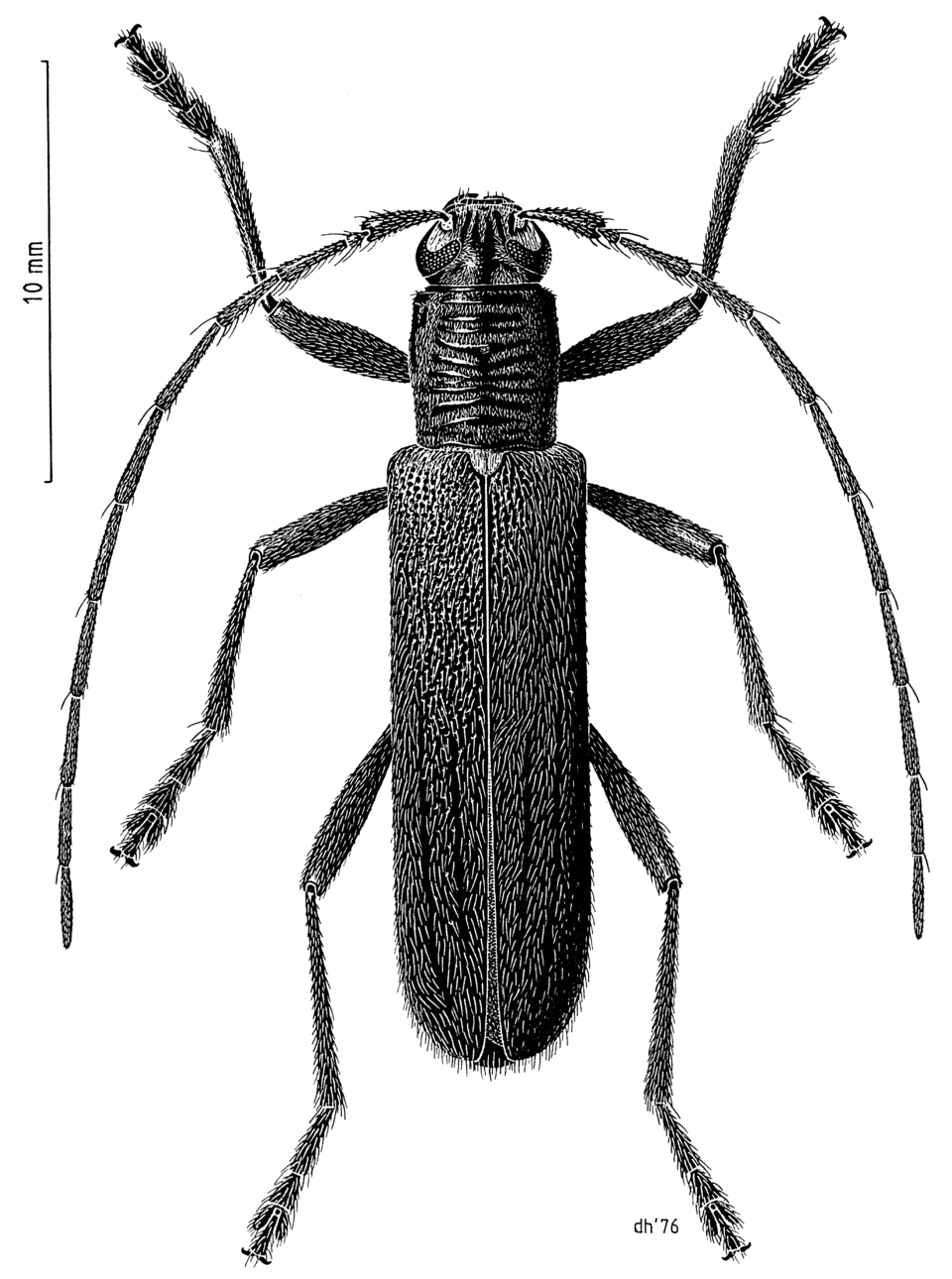
The lemon tree borer is a slim brown or black beetle with very long feelers. It lives only in New Zealand. When something grabs it, it squeaks by rubbing its head against its body, which is why people call it the singing beetle.
How big is it?
How long is it?
How big is Lemon tree borer compared to YOU?
Just maths in your browser. Nothing is saved or sent anywhere.
How fast is it?
Fun facts
It got its name because it badly damaged the first lemon and orange orchards in New Zealand.
One of the first ones ever collected was caught by the scientists on Captain Cook's ship, around 1770. It is still kept in a museum in London.
Its life takes about two years, and most of that time it is a baby living inside a tree.
The grown-ups come out at night and hide among leaves in the day.
When a baby damaged a manuka tree, the tree made a sweet liquid that Māori people liked to eat.
Most asked questions about Lemon tree borer
?Why is it called the singing beetle?
Because it squeaks when it is disturbed. It makes the sound by rubbing its head against a ridged part of its body.
?Is the lemon tree borer dangerous?
No, not to people. It only harms trees, because its babies tunnel through the wood.
?How big is the lemon tree borer?
The grown-up beetle is about 1.5 to 2.5 centimetres long, with feelers as long as its body or longer.
For bug experts
- Scientific name
- Oemona hirta
- Named by
- Fabricius, 1775
- Group
- Beetles
- Family
- Cerambycidae
- Classification
- Insecta > Coleoptera > Cerambycidae
- Lives on
- Australia and Oceania
- Also known as
- Whistling beetle, Singing beetle
Where the facts come from
- Oemona hirta (Wikipedia, CC BY-SA 4.0): what it looks like, where it lives, what it eats, sizes and fun facts, retold in simple words.
- Picture by Desmond W. Helmore. CC BY 4.0, Wikimedia Commons. The sticker of this bug is drawn from this picture.
If we got something wrong, sorry, we are bug fans, not a science journal. Tell us at [email protected] and we will fix it.
Bug Wiki honey jar For grown-ups: Bug Wiki is free, with no ads and no tracking. A small tip helps keep it online.Leave a tip Stag beetle
 Hercules beetle
 Common glow-worm
 Goliath beetle
 Cockchafer
 Mealworm beetle
 Eastern pine elfin
 Banded treebrown
 Sleepy duskywing
 American oak beauty
 April green cicada
 Gold-striped leaftier moth