
Lyside sulphur
Kricogonia lyside

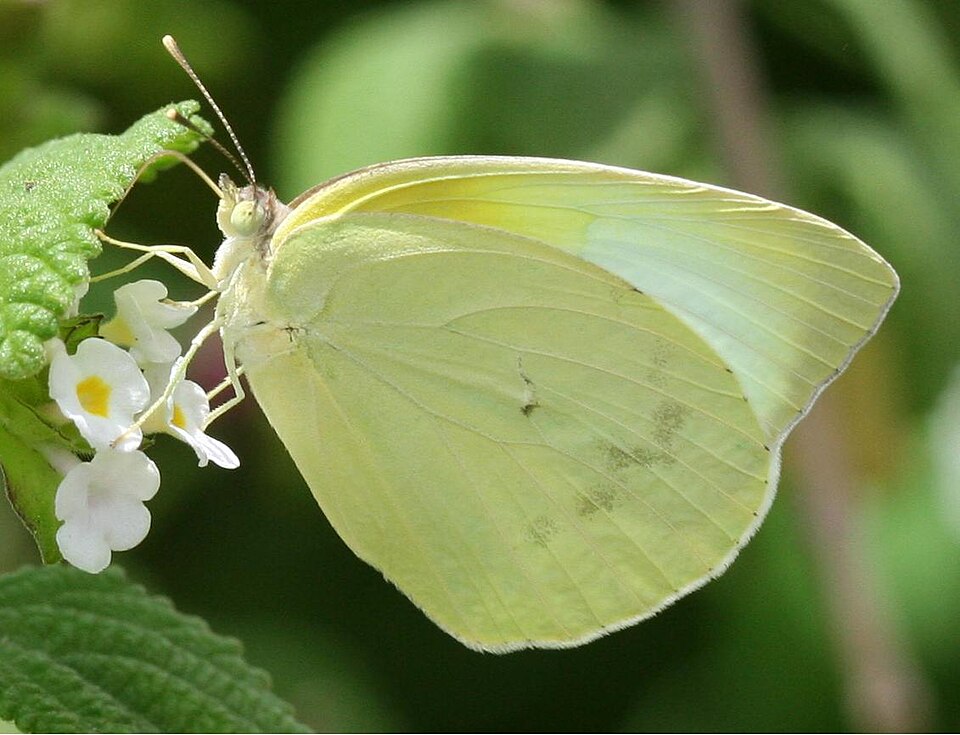
The lyside sulphur is a pale yellow butterfly. Many have a black bar on the back wing and a bright yellow patch near the body. Underneath, its wings can be greenish, yellow or almost white.
Lives in
Southern Texas and Arizona, Florida, the Caribbean and South America, in warm scrubland
Wingspan
3.8 to 6 cm (1.5 to 2.4 in)
Can it hurt you?
Harmless
Harmless. It does not bite or sting.
What does it eat?
The grown-ups drink from flowers. The caterpillars eat only the leaves of guayacan trees.
How big is it?
How wide are its wings?
🧱wings as wide as 2 toy building bricks⚽could fly across a whole football pitch in 25 seconds
How big is Lyside sulphur compared to YOU?
Just maths in your browser. Nothing is saved or sent anywhere.
How fast is it?
A person walking about 5 km/h (3.1 mph)
A kid running fast about 13 km/h (8.1 mph)
Lyside sulphur about 15 km/h (9.3 mph)
A grown-up on a bike about 25 km/h (16 mph)
cool stuff
Fun facts
1
After heavy rains, huge numbers of them can fly together in big migrations in Texas.
2
It is the only caterpillar known to eat plants of the guayacan family.
3
It can grow from an egg to a butterfly in as little as 13 days.
4
Its chrysalis is bluish green.
you asked
Most asked questions about Lyside sulphur
?What does the lyside sulphur eat?
Its caterpillars eat only guayacan leaves. The grown-ups drink from flowers.
?How big is the lyside sulphur?
Its open wings measure about 3.8 to 6 cm across.
For bug experts
- Scientific name
- Kricogonia lyside
- Group
- Butterflies
- Family
- Pieridae
- Classification
- Insecta > Lepidoptera > Pieridae
- Lives on
- North America, South America
- Also known as
- Guayacan sulphur
Where the facts come from
- Kricogonia lyside (Wikipedia, CC BY-SA 4.0): what it looks like, where it lives, what it eats, sizes and fun facts, retold in simple words.
- Picture by Kricogonia_lyside_1.jpg : Anne Toal from US derivative work: Berichard ( talk ). CC BY 2.0, Wikimedia Commons. The sticker of this bug is drawn from this picture.
If we got something wrong, sorry, we are bug fans, not a science journal. Tell us at [email protected] and we will fix it.
Bug Wiki honey jar For grown-ups: Bug Wiki is free, with no ads and no tracking. A small tip helps keep it online.Leave a tip Monarch butterfly
 Peacock butterfly
 Blue morpho
 Old World swallowtail
 Small white
 Eastern tiger swallowtail
 Black-headed sugar ant
 Steindachner's ebony tarantula
 Hebrew deathstalker
 Cactus scattered cochineal
 Black hairy scorpion
 Common whipspider