
Mango stem borer
Batocera rufomaculata

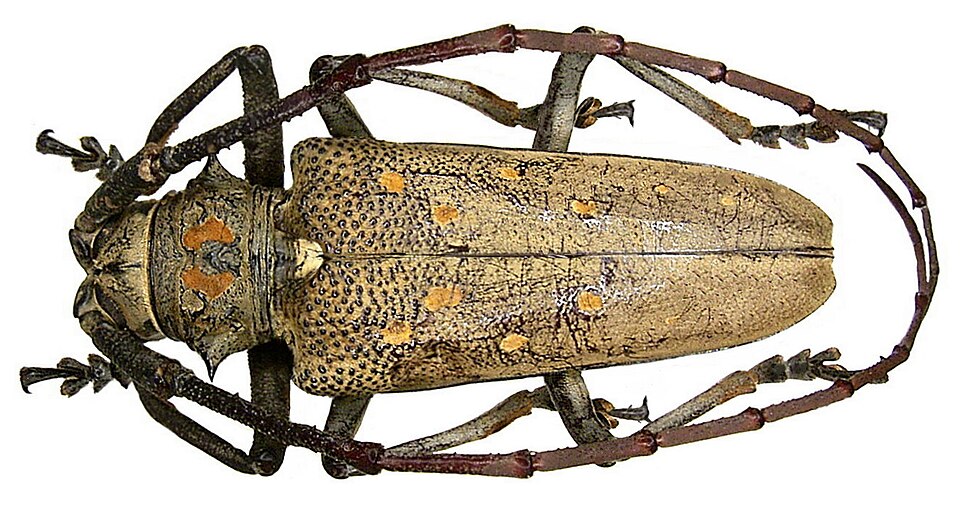
The mango stem borer is a longhorn beetle, a beetle with very long feelers. It comes from southern and south-eastern Asia. Its larvae tunnel inside the trunks of trees.
Lives in
Southern and south-eastern Asia, and brought to the Middle East, Africa's islands and the Caribbean
Can it hurt you?
Harmless
Harmless to people, but it can harm fruit trees.
What does it eat?
Its larvae bore into the trunks of mango, fig, papaya and other trees.
How fast is it?
A garden snail about 0.05 km/h (0.03 mph)
A tortoise about 0.3 km/h (0.19 mph)
Mango stem borer about 0.4 km/h (0.25 mph)
A person walking about 5 km/h (3.1 mph)
cool stuff
Fun facts
1
In mango orchards its larvae can make trees give less fruit or even die.
2
It lives naturally in places like India, China, Thailand and the Philippines.
3
Tiny wasps can lay their eggs in it and use it as food for their young.
you asked
Most asked questions about Mango stem borer
?Is the mango stem borer harmful?
It is harmless to people, but its larvae can kill mango and fig trees.
?Where does the mango stem borer come from?
From southern and south-eastern Asia, and it has spread to other warm countries.
For bug experts
- Scientific name
- Batocera rufomaculata
- Named by
- De Geer, 1775
- Group
- Beetles
- Family
- Cerambycidae
- Classification
- Insecta > Coleoptera > Cerambycidae
- Lives on
- Asia, Africa, North America
- Also known as
- MSB
Where the facts come from
- Batocera rufomaculata (Wikipedia, CC BY-SA 4.0): what it looks like, where it lives, what it eats, sizes and fun facts, retold in simple words.
- Picture by Udo Schmidt from Deutschland. CC BY-SA 2.0, Wikimedia Commons. The sticker of this bug is drawn from this picture.
If we got something wrong, sorry, we are bug fans, not a science journal. Tell us at [email protected] and we will fix it.
Bug Wiki honey jar For grown-ups: Bug Wiki is free, with no ads and no tracking. A small tip helps keep it online.Leave a tip Stag beetle
 Hercules beetle
 Common glow-worm
 Goliath beetle
 Cockchafer
 Mealworm beetle
 Black and scarlet cicada
 Glassy bluebottle
 One-spot grass yellow
 Isabella's longwing
 Tropical carpenter ant
 Cornelian
_(3833120393).jpg)