
One-spotted variant
Hypagyrtis unipunctata

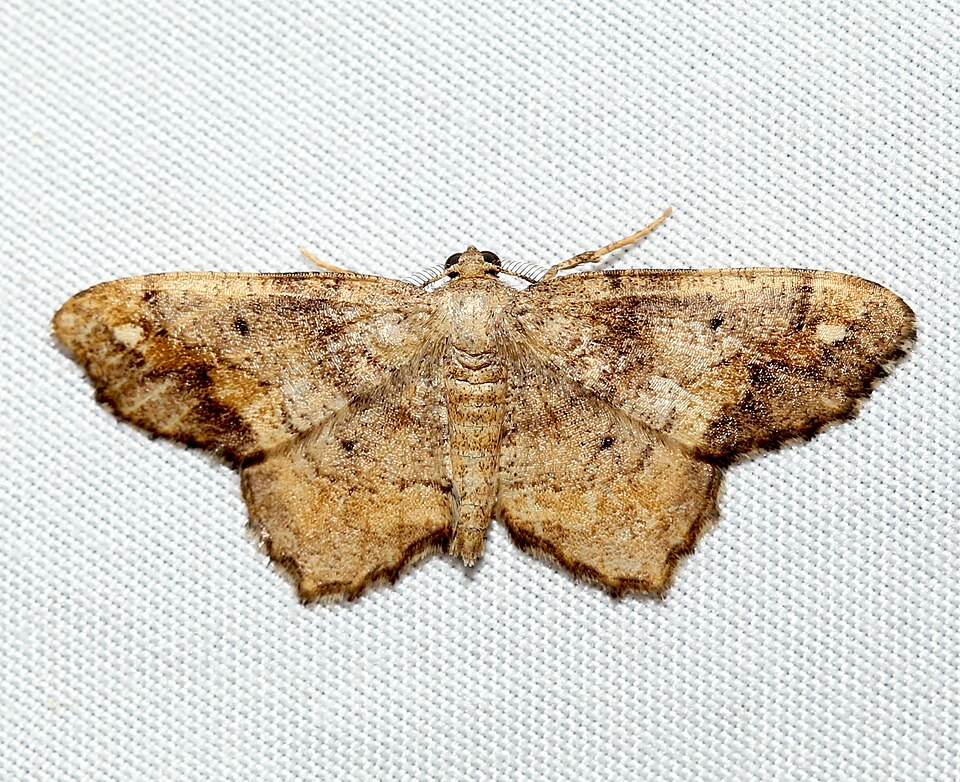
The one-spotted variant is a moth that comes in many sizes. Some are small and some are more than twice as big. Its other name, white spot, comes from a little pale spot on its wings.
Lives in
North America, from Canada to Florida and Texas, and also Europe and Asia
Wingspan
2 to 4.7 cm (0.79 to 1.9 in)
Can it hurt you?
Harmless
Harmless. It cannot bite or sting.
What does it eat?
Its caterpillars eat the leaves of many trees and bushes, like willow, birch, oak, maple and wild roses.
How big is it?
How wide are its wings?
🍚wings as wide as 8 grains of rice in a row⚽could fly across a whole football pitch in 25 seconds
How big is One-spotted variant compared to YOU?
Just maths in your browser. Nothing is saved or sent anywhere.
How fast is it?
A person walking about 5 km/h (3.1 mph)
A kid running fast about 13 km/h (8.1 mph)
One-spotted variant about 15 km/h (9.3 mph)
A grown-up on a bike about 25 km/h (16 mph)
cool stuff
Fun facts
1
Its wingspan can be anywhere from 20 to 47 millimetres, so big and small ones can look quite different.
2
In most of North America the moths fly from April to September.
3
Each year there are one or two families of young.
you asked
Most asked questions about One-spotted variant
?What does the one-spotted variant caterpillar eat?
Leaves of many trees and bushes, such as willow, birch, oak, maple and roses.
?How big is the one-spotted variant?
Its wings measure 20 to 47 millimetres across, so sizes vary a lot.
For bug experts
- Scientific name
- Hypagyrtis unipunctata
- Named by
- Haworth, 1809
- Group
- Moths
- Family
- Geometridae
- Classification
- Insecta > Lepidoptera > Geometridae
- Lives on
- North America, Europe, Asia
- Also known as
- One-spotted variant moth, White spot
Where the facts come from
- Hypagyrtis unipunctata (Wikipedia, CC BY-SA 4.0): what it looks like, where it lives, what it eats, sizes and fun facts, retold in simple words.
- Picture by NCBioTeacher. CC0, Wikimedia Commons. The sticker of this bug is drawn from this picture.
If we got something wrong, sorry, we are bug fans, not a science journal. Tell us at [email protected] and we will fix it.
Bug Wiki honey jar For grown-ups: Bug Wiki is free, with no ads and no tracking. A small tip helps keep it online.Leave a tip Atlas moth
 Luna moth
 Hummingbird hawk-moth
 Domestic silk moth
 Isabella tiger moth
 Polyphemus moth
 Bee beetle
 Witch-hazel cone gall aphid
 End band net-winged beetle
 Narrow green-banded swallowtail
 Common pine sawfly
 Southern pine beetle