
Rough-haired lagria beetle
Lagria hirta

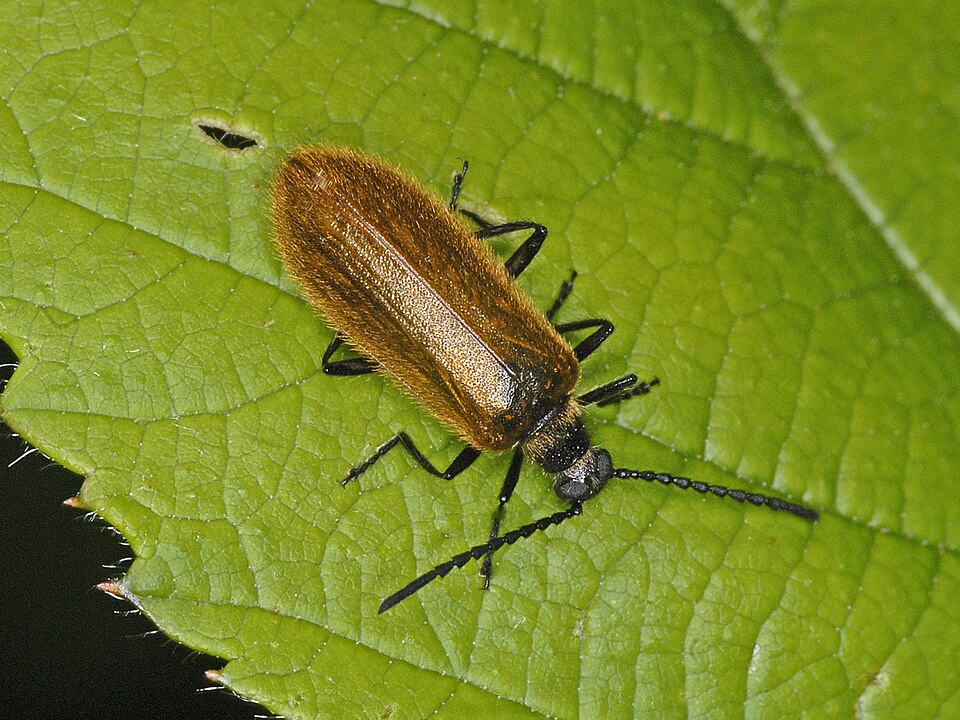
The rough-haired lagria beetle is a small, soft beetle with yellowish brown wing covers. Its whole body is covered in fine fuzzy hairs. It has big round eyes and black legs.
Lives in
Europe, North Africa and Asia, in meadows, forest edges and clearings
Length
7 to 8 mm (0.28 to 0.31 in)
Can it hurt you?
Harmless
Harmless. It does not bite or sting.
What does it eat?
The grown-up beetle eats nectar and pollen. Its larvae eat rotting plant bits in the soil.
How big is it?
How long is it?
💅small enough to sit on your fingernail🍽️could run across a dinner table in 9.7 seconds
How big is Rough-haired lagria beetle compared to YOU?
Just maths in your browser. Nothing is saved or sent anywhere.
How fast is it?
A garden snail about 0.05 km/h (0.03 mph)
A tortoise about 0.3 km/h (0.19 mph)
Rough-haired lagria beetle about 0.37 km/h (0.23 mph)
A person walking about 5 km/h (3.1 mph)
cool stuff
Fun facts
1
Its name hirta comes from a Latin word for rough hair, because it looks fuzzy.
2
Its eggs hatch in the soil after about eight days.
3
The boys have bigger eyes than the girls.
4
You can see the beetles from late May to September.
you asked
Most asked questions about Rough-haired lagria beetle
?Is the lagria beetle dangerous?
No. It is a small, fuzzy and harmless beetle.
?What does the rough-haired lagria beetle eat?
The adults eat nectar and pollen. The larvae eat rotting plants in the soil.
For bug experts
- Scientific name
- Lagria hirta
- Group
- Beetles
- Family
- Tenebrionidae
- Classification
- Insecta > Coleoptera > Tenebrionidae
- Lives on
- Europe, Africa, Asia
Where the facts come from
- Lagria hirta (Wikipedia, CC BY-SA 4.0): what it looks like, where it lives, what it eats, sizes and fun facts, retold in simple words.
- Picture by Hectonichus. CC BY-SA 3.0, Wikimedia Commons. The sticker of this bug is drawn from this picture.
If we got something wrong, sorry, we are bug fans, not a science journal. Tell us at [email protected] and we will fix it.
Bug Wiki honey jar For grown-ups: Bug Wiki is free, with no ads and no tracking. A small tip helps keep it online.Leave a tip Stag beetle
 Hercules beetle
 Common glow-worm
 Goliath beetle
 Cockchafer
 Mealworm beetle
 European tortoise bug
 Parthenice tiger moth
 Cactus lady beetle
 Celery leaftier moth
 Grey mantis
 Blue-green sharpshooter