
Spotted blisterbeetle
Ceroctis capensis

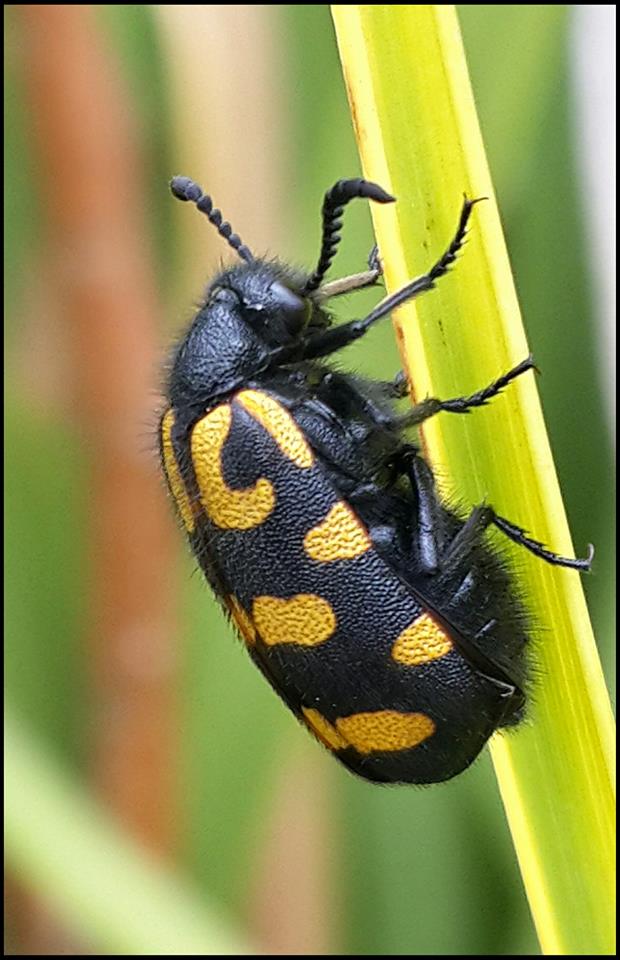
The spotted blister beetle is a black beetle with bright yellow spots from southern Africa. It flies slowly from flower to flower in the daytime.
Lives in
Southern Africa, on flowers in many kinds of places
Length
1.2 cm (0.47 in)
Can it hurt you?
Dangerous: look, do not touch
If it is grabbed, it lets out a liquid from its legs that makes blisters on skin, and it is poisonous to eat. Look, do not touch, and tell a grown-up if you see one.
What does it eat?
The grown-ups eat parts of flowers, especially pea-family flowers and Watsonia. Their babies eat the eggs of grasshoppers and locusts.
How big is it?
How long is it?
🍚as long as 2 grains of rice in a row🍽️could run across a dinner table in 8 seconds
How big is Spotted blisterbeetle compared to YOU?
Just maths in your browser. Nothing is saved or sent anywhere.
How fast is it?
A garden snail about 0.05 km/h (0.03 mph)
A tortoise about 0.3 km/h (0.19 mph)
Spotted blisterbeetle about 0.45 km/h (0.28 mph)
A person walking about 5 km/h (3.1 mph)
cool stuff
Fun facts
1
Its mother lays her eggs in the soil. The tiny babies then go looking for buried grasshopper eggs to eat.
2
Once a baby finds the grasshopper eggs, it changes into a fat, slug-like grub with very short legs.
3
By eating grasshopper eggs, its babies help keep the number of grasshoppers down.
you asked
Most asked questions about Spotted blisterbeetle
?What does the spotted blister beetle eat?
Grown-ups eat parts of flowers, and the young eat grasshopper and locust eggs.
For bug experts
- Scientific name
- Ceroctis capensis
- Group
- Beetles
- Family
- Meloidae
- Classification
- Insecta > Coleoptera > Meloidae
- Lives on
- Africa
- Also known as
- Spotted blister beetle
Where the facts come from
- Ceroctis capensis (Wikipedia, CC BY-SA 4.0): what it looks like, where it lives, what it eats, sizes and fun facts, retold in simple words.
- Picture by Juanita Vilas Marchant. CC BY-SA 4.0, Wikimedia Commons. The sticker of this bug is drawn from this picture.
If we got something wrong, sorry, we are bug fans, not a science journal. Tell us at [email protected] and we will fix it.
Bug Wiki honey jar For grown-ups: Bug Wiki is free, with no ads and no tracking. A small tip helps keep it online.Leave a tip Stag beetle
 Hercules beetle
 Common glow-worm
 Goliath beetle
 Cockchafer
 Mealworm beetle
 Red-flanked scymnus
 Australian variable lacewing
 Common thick-leg fly
 Northeastern sweat bee
 Masked vlei spider
 Sunflower burrowing-resin bee