
Striped meadowhawk
Sympetrum pallipes

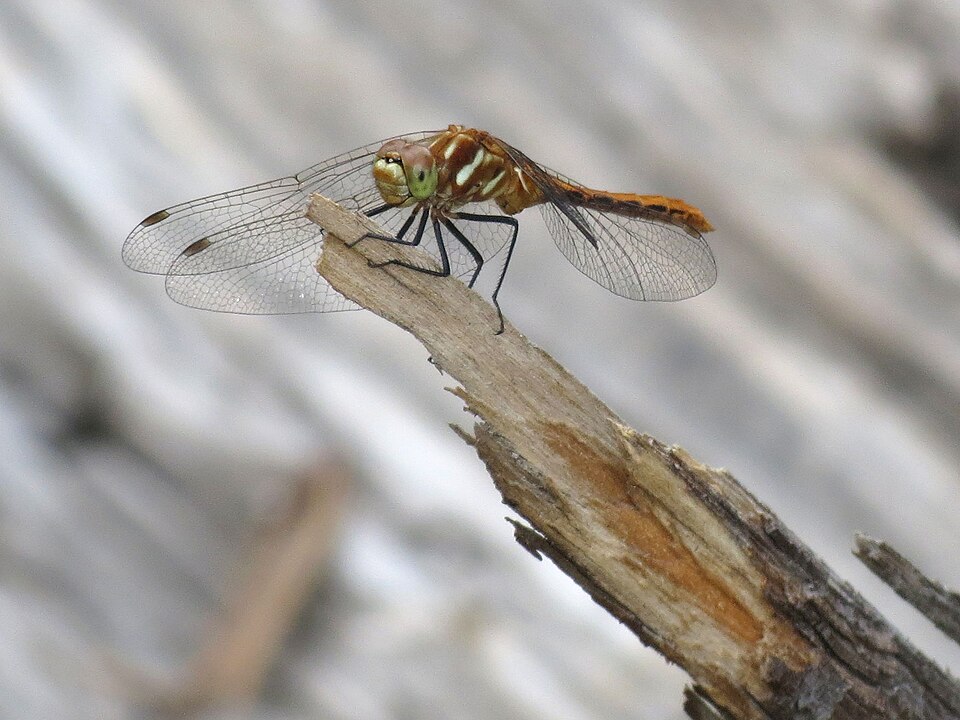
The striped meadowhawk is a dragonfly from North America. It belongs to the skimmers, a big family of dragonflies. It darts around in the sunshine, hunting small insects in the air.
Lives in
North America, near ponds and meadows
Can it hurt you?
Harmless
Harmless. Dragonflies have no sting and are no danger to people.
What does it eat?
Like all dragonflies, it catches small flying insects. Its young live in the water and hunt tiny water animals.
How fast is it?
A kid running fast about 13 km/h (8.1 mph)
A grown-up on a bike about 25 km/h (16 mph)
Striped meadowhawk about 40 km/h (25 mph)
A car driving in town about 50 km/h (31 mph)
cool stuff
Fun facts
1
It is a skimmer, a member of the dragonfly family called Libellulidae.
2
There are plenty of them, and scientists say the species is not in danger.
3
Like every dragonfly, it starts life in the water as a nymph before it climbs out and gets wings.
you asked
Most asked questions about Striped meadowhawk
?Does the striped meadowhawk sting?
No. Dragonflies have no sting and are harmless to people.
?Is the striped meadowhawk rare?
No. Its numbers are stable and it is not in danger.
For bug experts
- Scientific name
- Sympetrum pallipes
- Group
- Dragonflies and damselflies
- Family
- Libellulidae
- Classification
- Insecta > Odonata > Libellulidae
- Lives on
- North America
Where the facts come from
- Sympetrum pallipes (Wikipedia, CC BY-SA 4.0): what it looks like, where it lives, what it eats, sizes and fun facts, retold in simple words.
- Picture by Katja Schulz from Washington, D. C., USA. CC BY 2.0, Wikimedia Commons. The sticker of this bug is drawn from this picture.
If we got something wrong, sorry, we are bug fans, not a science journal. Tell us at [email protected] and we will fix it.
Bug Wiki honey jar For grown-ups: Bug Wiki is free, with no ads and no tracking. A small tip helps keep it online.Leave a tip Emperor dragonfly
 Common whitetail
 Green darner
 Ebony jewelwing
 Globe skimmer
 Blue dasher
 New Zealand mud snail
 Giant mayfly
 Great ramshorn
 Halcyon giant centipede
 Petroleum fly
 Buzzer midge
.jpg)