
Twice-stabbed stink bug
Cosmopepla lintneriana

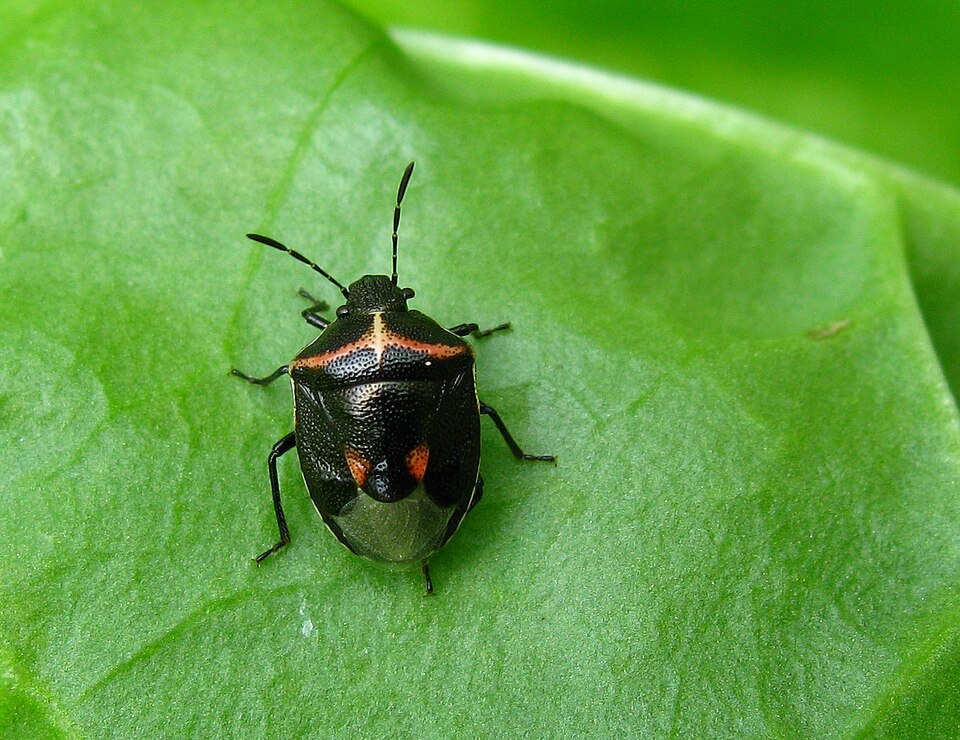
The twice-stabbed stink bug is a small shiny black bug. It has a red, orange or yellow band behind its head and two red spots near its back end. Its babies start out red or white with black marks.
Lives in
North America, from Canada to Mexico
Can it hurt you?
Harmless
Harmless. Like other stink bugs it can make a bad smell if you bother it.
What does it eat?
It sucks juice from many plants, like milk thistle, echinacea, asparagus, oats, mint and goldenrod.
How fast is it?
A garden snail about 0.05 km/h (0.03 mph)
Twice-stabbed stink bug about 0.2 km/h (0.12 mph)
A tortoise about 0.3 km/h (0.19 mph)
A person walking about 5 km/h (3.1 mph)
cool stuff
Fun facts
1
The colours of the babies change as they grow bigger.
2
Scientists described it twice under two different names, once in 1798 and again in 1865.
3
It has a short red stripe down the middle of its back.
you asked
Most asked questions about Twice-stabbed stink bug
?Is the twice-stabbed stink bug harmful?
No. It does not bite people. It may just smell bad if picked up.
?What does the twice-stabbed stink bug eat?
It feeds on many plants, such as mint, oats, asparagus and goldenrod.
For bug experts
- Scientific name
- Cosmopepla lintneriana
- Group
- True bugs and cicadas
- Family
- Pentatomidae
- Classification
- Insecta > Hemiptera > Pentatomidae
- Lives on
- North America
Where the facts come from
- Cosmopepla lintneriana (Wikipedia, CC BY-SA 4.0): what it looks like, where it lives, what it eats, sizes and fun facts, retold in simple words.
- Picture by Nihola. CC BY-SA 3.0, Wikimedia Commons. The sticker of this bug is drawn from this picture.
If we got something wrong, sorry, we are bug fans, not a science journal. Tell us at [email protected] and we will fix it.
Bug Wiki honey jar For grown-ups: Bug Wiki is free, with no ads and no tracking. A small tip helps keep it online.Leave a tip Pharaoh cicada
 Spotted lanternfly
 Brown marmorated stink bug
 Cochineal
 Boxelder bug
 Western conifer seed bug
 Common eastern bumblebee
 Tawny crazy ant
 Green-head ant
 Banded garden spider
 Brown-tail moth
 Common red soldier beetle