
Valerian psyllid
Trioza centranthi

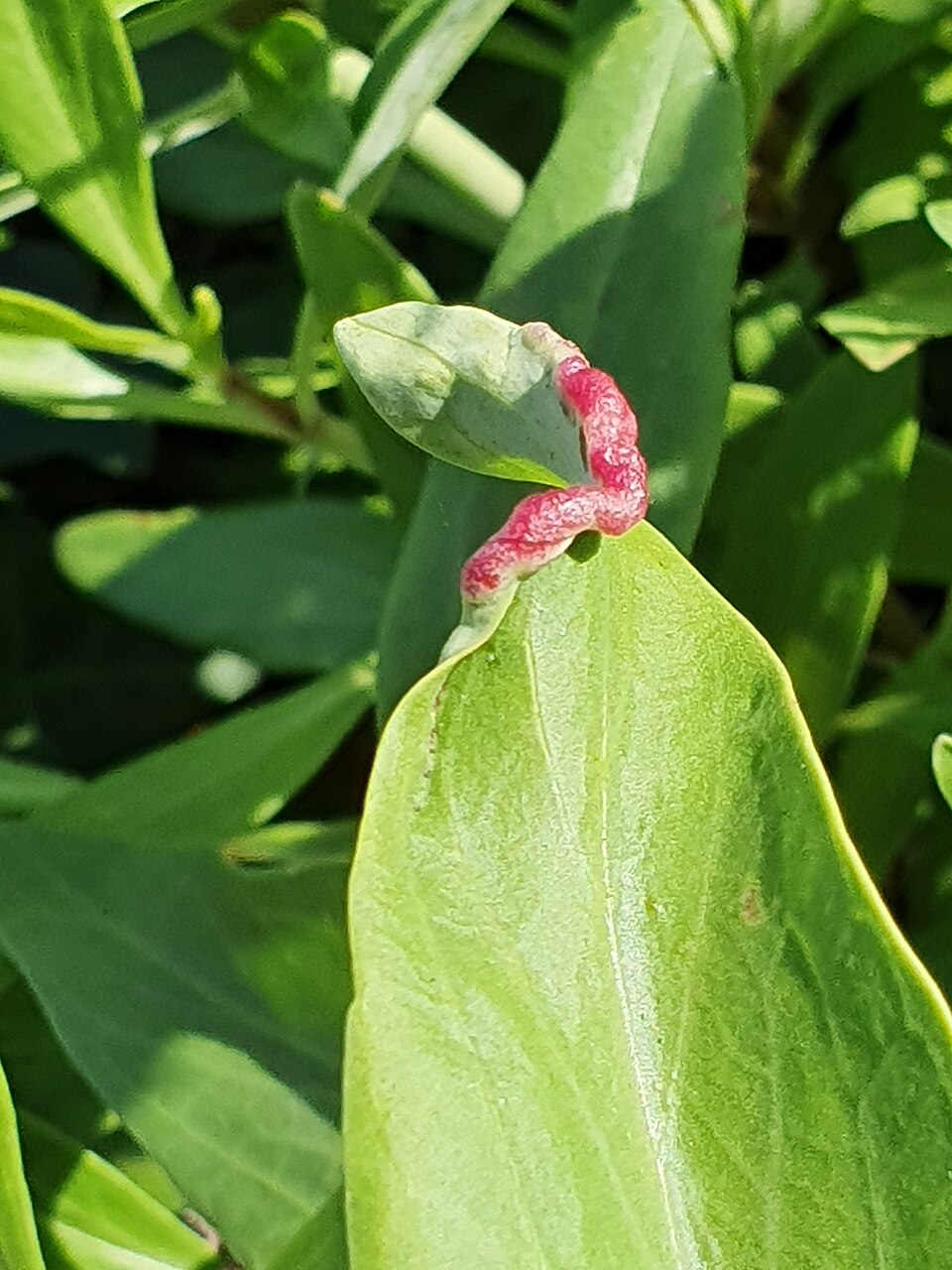
The valerian psyllid is a tiny bug that sucks sap from plants. It makes the leaves of red valerian and cornsalad grow in a strange, puffy way. These odd growths are called galls.
Lives in
Europe, from Great Britain and France to Ukraine
Can it hurt you?
Harmless
Harmless. It is tiny and does not bite people or sting.
What does it eat?
It drinks the sap of valerian and cornsalad plants through its tiny beak.
How fast is it?
A garden snail about 0.05 km/h (0.03 mph)
Valerian psyllid about 0.2 km/h (0.12 mph)
A tortoise about 0.3 km/h (0.19 mph)
A person walking about 5 km/h (3.1 mph)
cool stuff
Fun facts
1
Where it feeds, the top leaf grows wider than normal and its edges swell and curl upwards.
2
It can even turn flowers into a tangled ball of little leaves.
3
It lives on red valerian and on cornsalad, also called lamb's lettuce.
4
It was first described by a French insect scientist in 1829.
you asked
Most asked questions about Valerian psyllid
?What does the valerian psyllid do to plants?
It makes galls, so the leaves grow puffy and curled and the flowers turn leafy.
?Is the valerian psyllid dangerous?
No. It is a tiny, harmless sap-sucking bug.
For bug experts
- Scientific name
- Trioza centranthi
- Named by
- Vallot, 1829
- Group
- True bugs and cicadas
- Family
- Triozidae
- Classification
- Insecta > Hemiptera > Triozidae
- Lives on
- Europe
Where the facts come from
- Trioza centranthi (Wikipedia, CC BY-SA 4.0): what it looks like, where it lives, what it eats, sizes and fun facts, retold in simple words.
- Picture by Jowaninpensans. CC BY-SA 4.0, Wikimedia Commons. The sticker of this bug is drawn from this picture.
If we got something wrong, sorry, we are bug fans, not a science journal. Tell us at [email protected] and we will fix it.
Bug Wiki honey jar For grown-ups: Bug Wiki is free, with no ads and no tracking. A small tip helps keep it online.Leave a tip Pharaoh cicada
 Spotted lanternfly
 Brown marmorated stink bug
 Cochineal
 Boxelder bug
 Western conifer seed bug
 Ligated furrow bee
 Wall brown
 Spotted wolf spider
 Queensland fruit fly
 Hebrew character
 New Zealand red admiral