
White slant-line
Tetracis cachexiata

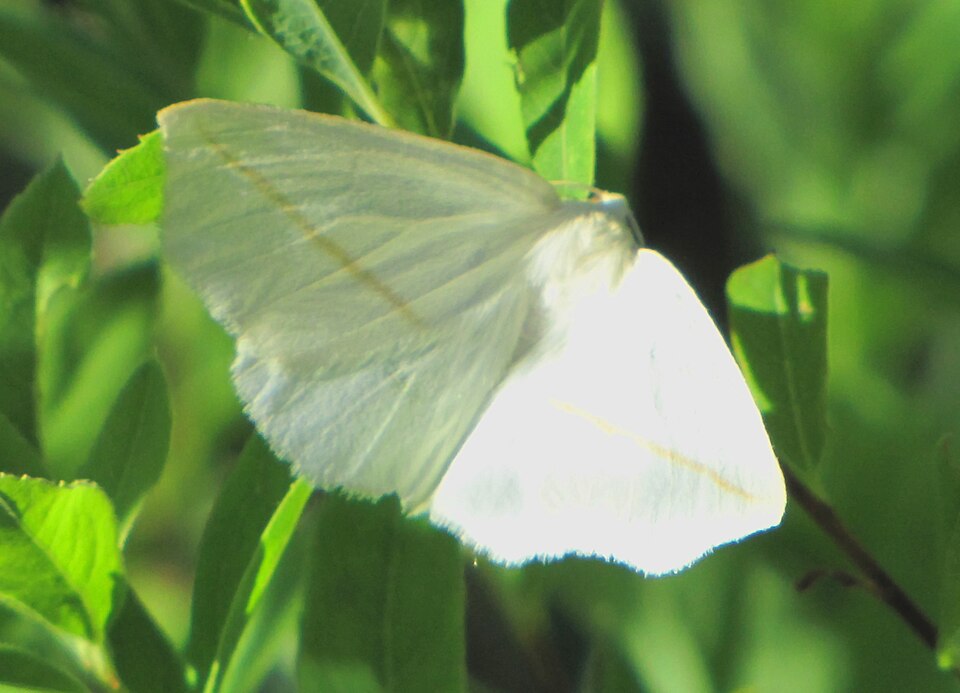
The white slant-line is a moth from North America that flies in late spring and early summer. Its caterpillars eat the leaves of both leafy trees and evergreen trees. It lives across a huge part of Canada and the United States.
Lives in
North America, from Nova Scotia to British Columbia and south to Florida
Can it hurt you?
Harmless
Harmless. It cannot bite or sting.
What does it eat?
Its caterpillars eat many trees, such as alder, birch, willow, elm, pine, larch and fir.
How fast is it?
A person walking about 5 km/h (3.1 mph)
A kid running fast about 13 km/h (8.1 mph)
White slant-line about 14 km/h (8.7 mph)
A grown-up on a bike about 25 km/h (16 mph)
cool stuff
Fun facts
1
Its front wings are 19 to 26 millimetres long.
2
It flies from May to early July.
3
Its caterpillars eat needles of conifers like pine and hemlock, as well as ordinary leaves.
you asked
Most asked questions about White slant-line
?What does the white slant-line eat?
Its caterpillars eat leaves of many trees, and even pine and fir needles.
?When does the white slant-line fly?
From May to early July.
For bug experts
- Scientific name
- Tetracis cachexiata
- Named by
- Guenée, 1858
- Group
- Moths
- Family
- Geometridae
- Classification
- Insecta > Lepidoptera > Geometridae
- Lives on
- North America
- Also known as
- White slaut
Where the facts come from
- Tetracis cachexiata (Wikipedia, CC BY-SA 4.0): what it looks like, where it lives, what it eats, sizes and fun facts, retold in simple words.
- Picture by D. Gordon E. Robertson. CC BY-SA 3.0, Wikimedia Commons. The sticker of this bug is drawn from this picture.
If we got something wrong, sorry, we are bug fans, not a science journal. Tell us at [email protected] and we will fix it.
Bug Wiki honey jar For grown-ups: Bug Wiki is free, with no ads and no tracking. A small tip helps keep it online.Leave a tip Atlas moth
 Luna moth
 Hummingbird hawk-moth
 Domestic silk moth
 Isabella tiger moth
 Polyphemus moth
 Robust oak borer
 Tasmanian inchman ant
 Common triangular spider
 Northern fruit bug
 Gray comma
 Red jewel bug