
Burnet companion
Euclidia glyphica

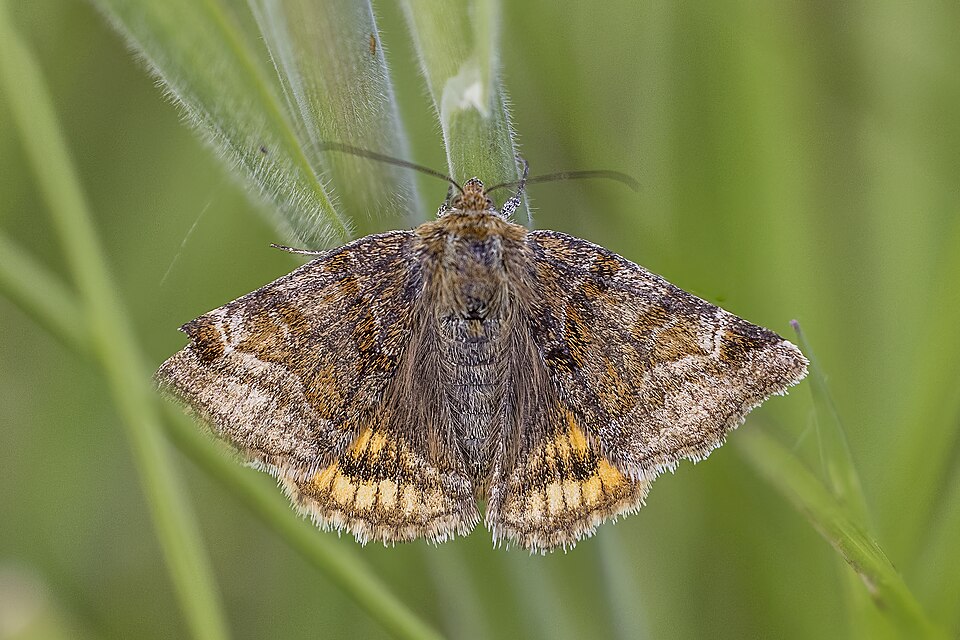
The burnet companion is a small brown moth with dark bands across its front wings. When it opens up, it shows back wings of bright orange with dark stripes. It lives in grassy meadows full of clover.
Lives in
From Ireland across Europe and Asia to Mongolia and Siberia, and in North Africa
Can it hurt you?
Harmless
Harmless. It cannot bite or sting people, so you can watch it up close.
What does it eat?
Its caterpillars eat clover, especially red clover, and also vetches, alfalfa and violets.
How fast is it?
A person walking about 5 km/h (3.1 mph)
A kid running fast about 13 km/h (8.1 mph)
Burnet companion about 14 km/h (8.7 mph)
A grown-up on a bike about 25 km/h (16 mph)
cool stuff
Fun facts
1
Its caterpillar is yellowish or reddish brown with two dark streaks on its head.
2
In Britain most of them are darker brown than in other places.
3
It lives across a huge area, from Ireland in the west to Siberia in the east.
you asked
Most asked questions about Burnet companion
?What does the burnet companion caterpillar eat?
Clover, vetches, alfalfa and other meadow plants.
?What colour is the burnet companion moth?
Its front wings are brown with dark bands, and its back wings are orange with dark stripes.
For bug experts
- Scientific name
- Euclidia glyphica
- Group
- Moths
- Family
- Erebidae
- Classification
- Insecta > Lepidoptera > Erebidae
- Lives on
- Europe, Asia, Africa
Where the facts come from
- Burnet companion (Wikipedia, CC BY-SA 4.0): what it looks like, where it lives, what it eats, sizes and fun facts, retold in simple words.
- Picture by Charles J. Sharp. CC BY-SA 4.0, Wikimedia Commons. The sticker of this bug is drawn from this picture.
If we got something wrong, sorry, we are bug fans, not a science journal. Tell us at [email protected] and we will fix it.
Bug Wiki honey jar For grown-ups: Bug Wiki is free, with no ads and no tracking. A small tip helps keep it online.Leave a tip Atlas moth
 Luna moth
 Hummingbird hawk-moth
 Domestic silk moth
 Isabella tiger moth
 Polyphemus moth
 Dusky meadow brown
 Slender green-winged grasshopper
 Rufous-legged grasshopper
 Spotless grass yellow
 Lupine aphid
 Field crescent
_Burren.jpg)