
Golden gem
Libellago lineata

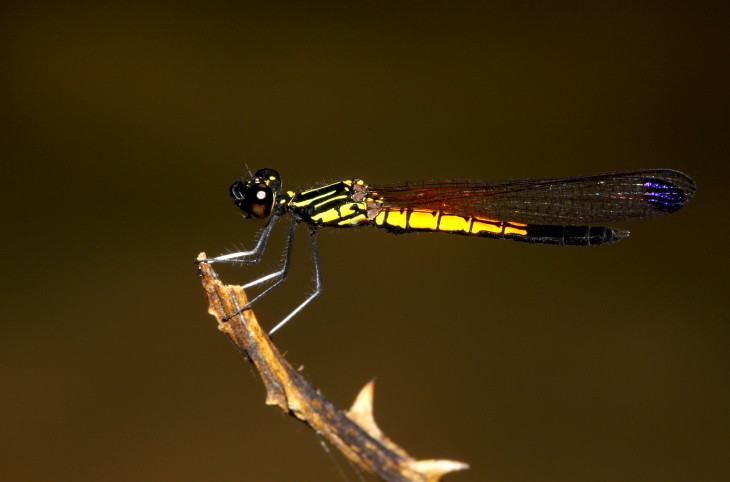
The golden gem is a damselfly, a slim cousin of the dragonfly. It lives in many countries in Asia. Look for it near clear streams and rivers, where it flits over the water.
Lives in
Many countries in Asia, by clear streams and rivers
Can it hurt you?
Harmless
Harmless. Damselflies have no sting and do not hurt people.
What does it eat?
Like other damselflies, it catches small insects. Its babies grow up under water and hunt tiny water animals there.
How fast is it?
A person walking about 5 km/h (3.1 mph)
Golden gem about 10 km/h (6.2 mph)
A kid running fast about 13 km/h (8.1 mph)
A grown-up on a bike about 25 km/h (16 mph)
cool stuff
Fun facts
1
Another name for it is the river heliodor.
2
Scientists once split it into three kinds, called subspecies, from different parts of Asia.
3
Two of those kinds, from the Andaman Islands and from South India, are now counted as species of their own.
you asked
Most asked questions about Golden gem
?Is the golden gem dangerous?
No. It is a damselfly, and damselflies have no sting.
?Where does the golden gem live?
In many Asian countries, near clear streams and rivers.
For bug experts
- Scientific name
- Libellago lineata
- Named by
- Burmeister, 1839
- Group
- Dragonflies and damselflies
- Family
- Chlorocyphidae
- Classification
- Insecta > Odonata > Chlorocyphidae
- Lives on
- Asia
- Also known as
- River heliodor
Where the facts come from
- Libellago lineata (Wikipedia, CC BY-SA 4.0): what it looks like, where it lives, what it eats, sizes and fun facts, retold in simple words.
- Picture by Balakrishnan Valappil. CC BY-SA 2.0, Wikimedia Commons. The sticker of this bug is drawn from this picture.
If we got something wrong, sorry, we are bug fans, not a science journal. Tell us at [email protected] and we will fix it.
Bug Wiki honey jar For grown-ups: Bug Wiki is free, with no ads and no tracking. A small tip helps keep it online.Leave a tip Emperor dragonfly
 Common whitetail
 Green darner
 Ebony jewelwing
 Globe skimmer
 Blue dasher
 Orange-spotted drone fly
 Red marsh ladybird
 Black-footed drone fly
 Marsh lady beetle
 Clipped-winged grasshopper
 Dark-winged chrysogaster
.jpg)