
Large dark olive
Baetis rhodani

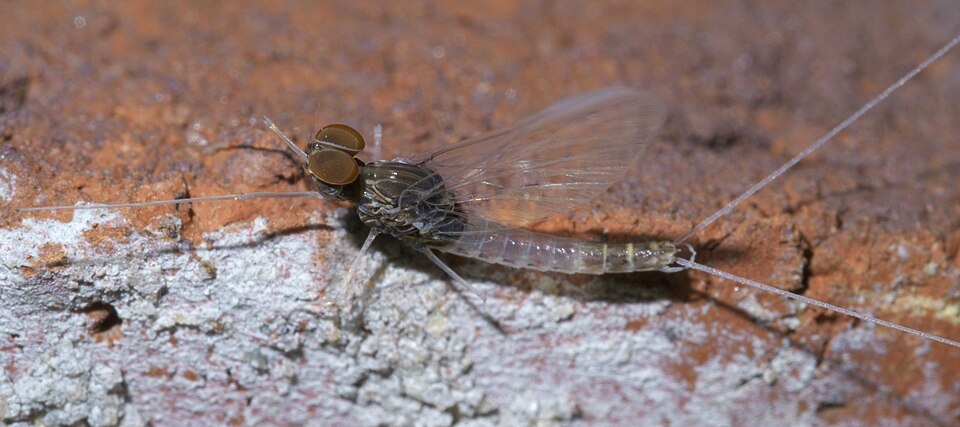
The large dark olive is a delicate little mayfly from Europe. It starts life as a nymph living under water in streams and rivers. When it grows up, it flies up into the air on thin, see-through wings.
Lives in
Europe, near streams and rivers
Can it hurt you?
Harmless
Harmless. Mayflies have no sting and cannot bite.
What does it eat?
The grown-up mayflies do not eat at all. The nymphs live in the water and feed there before they grow wings.
How fast is it?
A person walking about 5 km/h (3.1 mph)
Large dark olive about 5 km/h (3.1 mph)
A kid running fast about 13 km/h (8.1 mph)
A grown-up on a bike about 25 km/h (16 mph)
cool stuff
Fun facts
1
Fishermen call mayflies like this one blue-winged olives and copy them to make fishing flies.
2
Its group has more than 150 kinds of mayflies all around the world.
3
About 48 kinds of these mayflies live in Europe.
you asked
Most asked questions about Large dark olive
?Do mayflies eat?
The grown-ups do not eat at all. Only the young nymphs in the water feed.
?Are mayflies dangerous?
No. They have no sting and cannot bite.
?Where do mayfly babies live?
They live under water in streams and rivers until they are ready to fly.
For bug experts
- Scientific name
- Baetis rhodani
- Named by
- Pictet, 1843
- Group
- Other insects
- Family
- Baetidae
- Classification
- Insecta > Ephemeroptera > Baetidae
- Lives on
- Europe
Where the facts come from
- Baetis (Wikipedia, CC BY-SA 4.0): what it looks like, where it lives, what it eats, sizes and fun facts, retold in simple words.
- Picture by xpda. CC BY-SA 4.0, Wikimedia Commons. The sticker of this bug is drawn from this picture.
If we got something wrong, sorry, we are bug fans, not a science journal. Tell us at [email protected] and we will fix it.
Bug Wiki honey jar For grown-ups: Bug Wiki is free, with no ads and no tracking. A small tip helps keep it online.Leave a tip Common earwig
 Silverfish
 Chigoe flea
 Giant earwig
 Grannom
 Firebrat
 Pale snaketail
 Marsh-cricket
 Flag-tailed spinyleg
 Black setwing
 Coastal tiger beetle
 Emperor dragonfly