
Orange-belted leafwalker

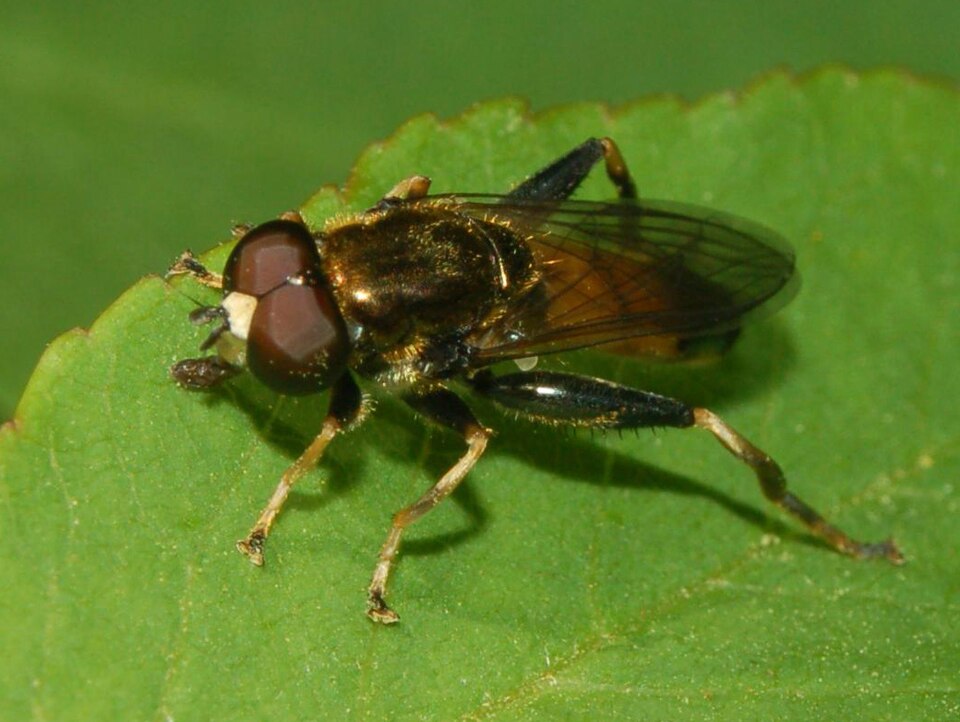
The orange-belted leafwalker is a slim hoverfly with a black body and a big orange-red patch on its tummy. It is a bit lazy. Instead of zooming from flower to flower, it mostly walks around on leaves.
How big is it?
How long is it?
How big is Orange-belted leafwalker compared to YOU?
Just maths in your browser. Nothing is saved or sent anywhere.
How fast is it?
Fun facts
Its scientific name can be translated as lazy wood fly, because it rarely flies and likes to sit on leaves.
It has reddish eyes and spiny back legs.
There can be up to three families of young in one year, and adults fly from April to September.
Its larvae spend the winter and turn into adults in spring.
Most asked questions about Orange-belted leafwalker
?Can the orange-belted leafwalker sting?
No. It is a hoverfly and cannot sting.
?What does the orange-belted leafwalker eat?
Mostly pollen lying on leaves and honeydew from aphids.
For bug experts
- Scientific name
- Xylota segnis
- Group
- Flies and mosquitoes
- Family
- Syrphidae
- Classification
- Insecta > Diptera > Syrphidae
- Lives on
- Europe, Asia, North America
- Also known as
- Brown-toed forest fly
Where the facts come from
- Xylota segnis (Wikipedia, CC BY-SA 4.0): what it looks like, where it lives, what it eats, sizes and fun facts, retold in simple words.
- Picture by Hectonichus. CC BY-SA 4.0, Wikimedia Commons. The sticker of this bug is drawn from this picture.
If we got something wrong, sorry, we are bug fans, not a science journal. Tell us at [email protected] and we will fix it.
Bug Wiki honey jar For grown-ups: Bug Wiki is free, with no ads and no tracking. A small tip helps keep it online.Leave a tip Housefly
 New World screwworm fly
 Lovebug
 Tsetse fly
 Common fruit fly
 Asian tiger mosquito
 Northern two-striped walkingstick
 Pale brindled beauty
 March tubic
 Red-green carpet
 Canadian melanolophia moth
 Darling underwing
.JPG)