
Giant lacewing
Osmylus fulvicephalus

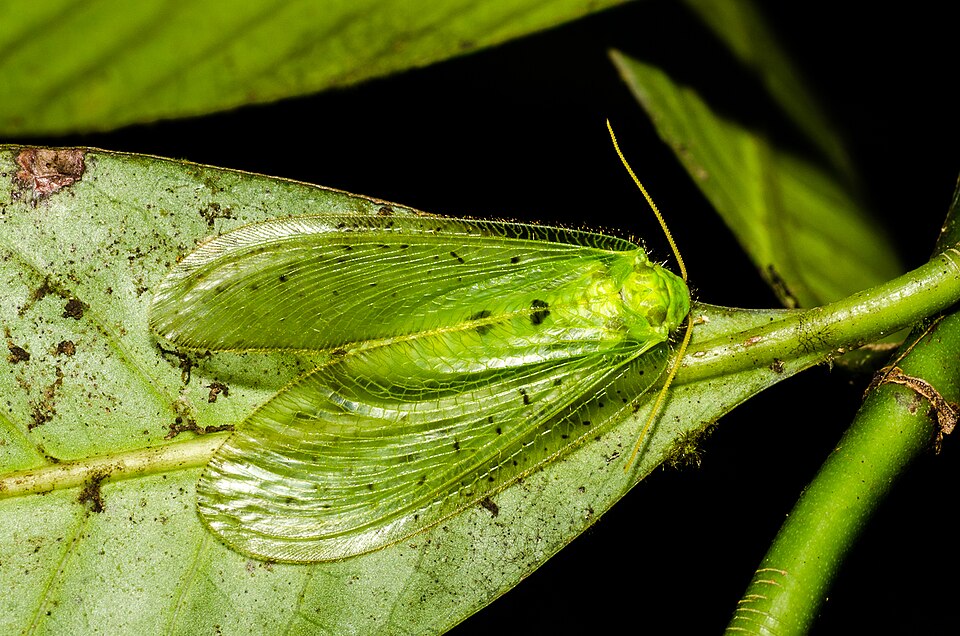
The giant lacewing is a large lacewing with four see-through wings covered in a fine net of veins and dark spots. Its head is orange-yellow. It likes shady places beside streams.
Lives in
Europe, in shady woods beside streams
Can it hurt you?
Harmless
Harmless. It does not sting and does not hurt people.
What does it eat?
It is a hunter. Its larvae live in damp moss by streams and catch other small insect larvae.
How fast is it?
Giant lacewing about 3 km/h (1.9 mph)
A person walking about 5 km/h (3.1 mph)
A kid running fast about 13 km/h (8.1 mph)
A grown-up on a bike about 25 km/h (16 mph)
cool stuff
Fun facts
1
Its name fulvicephalus means tawny head, because of its orange-yellow head.
2
Its wings are folded over its back like a little roof when it rests.
3
Its larvae have long, pointed jaws for catching prey.
you asked
Most asked questions about Giant lacewing
?Is the giant lacewing dangerous?
No. It is harmless to people.
?Where does the giant lacewing live?
In shady woods next to streams in Europe.
For bug experts
- Scientific name
- Osmylus fulvicephalus
- Group
- Other insects
- Family
- Osmylidae
- Classification
- Insecta > Neuroptera > Osmylidae
- Lives on
- Europe
Where the facts come from
- Ithonidae (Wikipedia, CC BY-SA 4.0): what it looks like, where it lives, what it eats, sizes and fun facts, retold in simple words.
- Picture by Kesavamurthy N. CC BY-SA 3.0, Wikimedia Commons. The sticker of this bug is drawn from this picture.
If we got something wrong, sorry, we are bug fans, not a science journal. Tell us at [email protected] and we will fix it.
Bug Wiki honey jar For grown-ups: Bug Wiki is free, with no ads and no tracking. A small tip helps keep it online.Leave a tip Common earwig
 Silverfish
 Chigoe flea
 Giant earwig
 Grannom
 Firebrat
 Pole borer
 White-striped black
 Beech scale
 Commander
 Oak lace bug
 Shaded orbweaver