
Round-tipped conehead
Neoconocephalus retusus

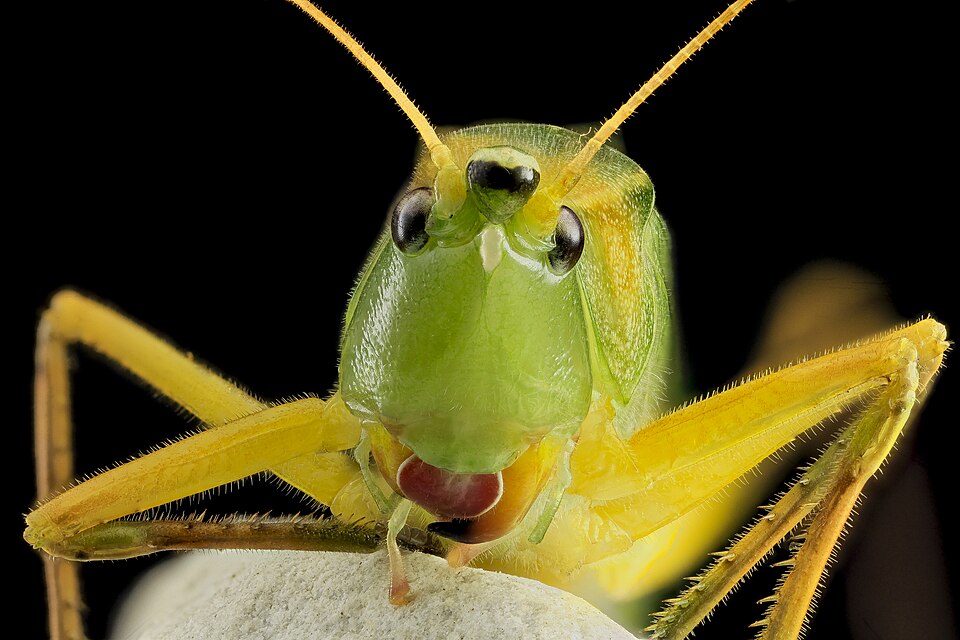
The round-tipped conehead is a katydid, a cousin of grasshoppers with very long feelers. It is quite big, about as long as your finger. You can find it in wet, grassy and weedy places at the end of summer.
Lives in
Eastern United States and southern Canada, in wet grassy places
Length
3.7 to 5.2 cm (1.5 to 2 in)
Can it hurt you?
Harmless
Harmless. It cannot sting.
What does it eat?
Not much is written about what it eats. Coneheads like it mostly nibble on grasses and their seeds.
How big is it?
How long is it?
🍚as long as 9 grains of rice in a row🧱as long as 1.5 toy building bricks in a row🍽️could run across a dinner table in 0.8 seconds⚡moves 26 times its own body length every second
How big is Round-tipped conehead compared to YOU?
Just maths in your browser. Nothing is saved or sent anywhere.
How fast is it?
Round-tipped conehead about 4.8 km/h (3 mph)
A person walking about 5 km/h (3.1 mph)
A kid running fast about 13 km/h (8.1 mph)
A grown-up on a bike about 25 km/h (16 mph)
cool stuff
Fun facts
1
Grown-ups are seen in August, September and October.
2
It belongs to the katydids, which are also called bush crickets.
3
It is one of the bigger insects in grassy fields, up to about 5 centimetres long.
you asked
Most asked questions about Round-tipped conehead
?Is the round-tipped conehead dangerous?
No. It is a harmless katydid that cannot sting.
?How big is the round-tipped conehead?
Grown-ups are about 4 to 5 centimetres long.
For bug experts
- Scientific name
- Neoconocephalus retusus
- Group
- Grasshoppers and crickets
- Family
- Tettigoniidae
- Classification
- Insecta > Orthoptera > Tettigoniidae
- Lives on
- North America
Where the facts come from
- Neoconocephalus retusus (Wikipedia, CC BY-SA 4.0): what it looks like, where it lives, what it eats, sizes and fun facts, retold in simple words.
- Picture by USGS Bee Inventory and Monitoring Lab from Beltsville, USA. CC BY 2.0, Wikimedia Commons. The sticker of this bug is drawn from this picture.
If we got something wrong, sorry, we are bug fans, not a science journal. Tell us at [email protected] and we will fix it.
Bug Wiki honey jar For grown-ups: Bug Wiki is free, with no ads and no tracking. A small tip helps keep it online.Leave a tip Desert locust
 House cricket
 Parktown prawn
 Eastern lubber grasshopper
 Australian plague locust
 Mormon cricket
 Two-spotted melyrid
 Fighting spider
 Stern jumping spider
 Peppertree psyllid
 Small pugnacious ant
 Double-banded plushback
.jpg)