
Blue long-horned snailkiller
Sepedon sphegea

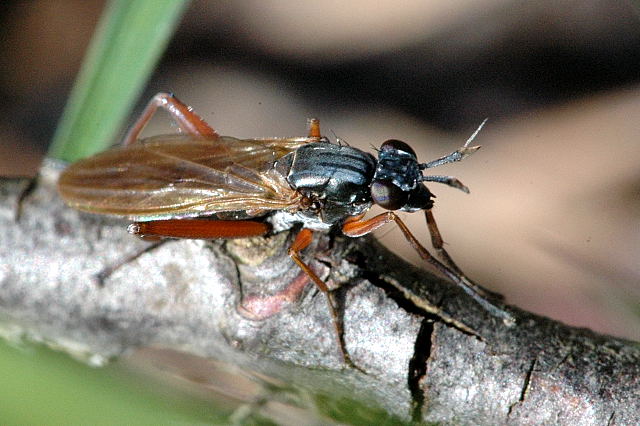
The blue long-horned snailkiller is a fly that lives at the edges of ponds. It belongs to the marsh flies, also called snail-killing flies. That name comes from what its babies eat.
Lives in
Europe and Asia, at pond edges and in damp meadows
Can it hurt you?
Harmless
Harmless to people. It is only dangerous if you are a water snail.
What does it eat?
Its larva hunts snails that live in the water. When it gets the chance, it also eats other small creatures.
How fast is it?
A person walking about 5 km/h (3.1 mph)
Blue long-horned snailkiller about 8 km/h (5 mph)
A kid running fast about 13 km/h (8.1 mph)
A grown-up on a bike about 25 km/h (16 mph)
cool stuff
Fun facts
1
It is especially fond of yellow iris plants that grow at the edge of ponds.
2
Adults can be seen all year round, but most of them fly from March to October.
3
Its long feelers stick out in front of its head, which is where the long-horned part of its name comes from.
you asked
Most asked questions about Blue long-horned snailkiller
?Is the snailkiller fly dangerous?
No. It is harmless to people. Only its larvae hunt, and they eat snails.
?What does a snail-killing fly eat?
Its larvae eat water snails and sometimes other small creatures.
For bug experts
- Scientific name
- Sepedon sphegea
- Group
- Flies and mosquitoes
- Family
- Sciomyzidae
- Classification
- Insecta > Diptera > Sciomyzidae
- Lives on
- Europe, Asia
Where the facts come from
- Sepedon sphegea (Wikipedia, CC BY-SA 4.0): what it looks like, where it lives, what it eats, sizes and fun facts, retold in simple words.
- Picture by James K. Lindsey. CC BY-SA 3.0, Wikimedia Commons. The sticker of this bug is drawn from this picture.
If we got something wrong, sorry, we are bug fans, not a science journal. Tell us at [email protected] and we will fix it.
Bug Wiki honey jar For grown-ups: Bug Wiki is free, with no ads and no tracking. A small tip helps keep it online.Leave a tip Housefly
 New World screwworm fly
 Lovebug
 Tsetse fly
 Common fruit fly
 Asian tiger mosquito
 Asian blood tail
 Orange-striped stonefly
 Radon Saint Andrew's cross spider
 California darner
 Lesser cream wave
 Lake pondskater