
Eastern ten-spotted ladybug
Microcaria pupillata

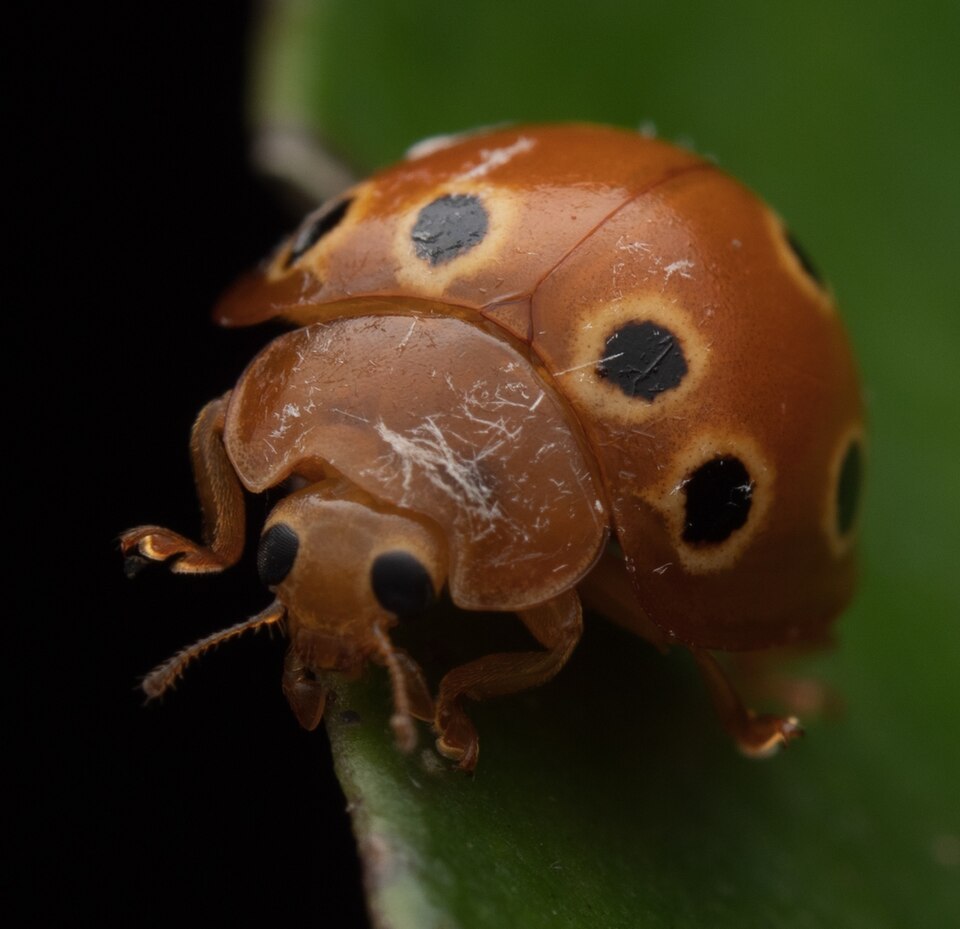
The eastern ten-spotted ladybug is a reddish-brown ladybird from Asia. Each wing case has five black spots, and every spot has a yellowish ring around it, like a little eye. Five plus five makes ten spots.
Lives in
South and Southeast Asia: India, Nepal, China, Thailand and Indonesia
Length
5.2 to 6 mm (0.2 to 0.24 in)
Can it hurt you?
Harmless
Harmless. It cannot hurt you.
What does it eat?
It hunts aphids, including the aphids that live on orange and lemon trees.
How big is it?
How long is it?
💅small enough to sit on your fingernail⚽could fly across a whole football pitch in 13 seconds⚡moves 1400 times its own body length every second
How big is Eastern ten-spotted ladybug compared to YOU?
Just maths in your browser. Nothing is saved or sent anywhere.
How fast is it?
A kid running fast about 13 km/h (8.1 mph)
A grown-up on a bike about 25 km/h (16 mph)
Eastern ten-spotted ladybug about 30 km/h (19 mph)
A car driving in town about 50 km/h (31 mph)
cool stuff
Fun facts
1
It is about 5 to 6 millimetres long, a bit smaller than a pea.
2
The shield behind its head has both dark and pale patches.
3
It lives as far apart as the Himalayas in Nepal and the Andaman Islands in the sea.
you asked
Most asked questions about Eastern ten-spotted ladybug
?How many spots does the eastern ten-spotted ladybug have?
Ten: five black spots on each wing case, each with a yellowish ring.
?What does the eastern ten-spotted ladybug eat?
Aphids, including those that live on orange and lemon trees.
For bug experts
- Scientific name
- Microcaria pupillata
- Group
- Ladybirds
- Family
- Coccinellidae
- Classification
- Insecta > Coleoptera > Coccinellidae
- Lives on
- Asia
Where the facts come from
- Microcaria pupillata (Wikipedia, CC BY-SA 4.0): what it looks like, where it lives, what it eats, sizes and fun facts, retold in simple words.
- Picture by that_bee_guy. CC BY 4.0, Wikimedia Commons. The sticker of this bug is drawn from this picture.
If we got something wrong, sorry, we are bug fans, not a science journal. Tell us at [email protected] and we will fix it.
Bug Wiki honey jar For grown-ups: Bug Wiki is free, with no ads and no tracking. A small tip helps keep it online.Leave a tip Seven-spot ladybird
 Harlequin ladybird
 Mealybug destroyer
 Twenty-two-spot ladybird
 Twice-stabbed ladybird
 Spotted pink ladybird
 Lesser broad-bordered yellow underwing
 V-pug
V-pug Nettle ground bug
 Horehound bug
 Dogbane saucrobotys moth
 Lesser bloody-nosed beetle