
Marsh snipe fly
Rhagio tringarius

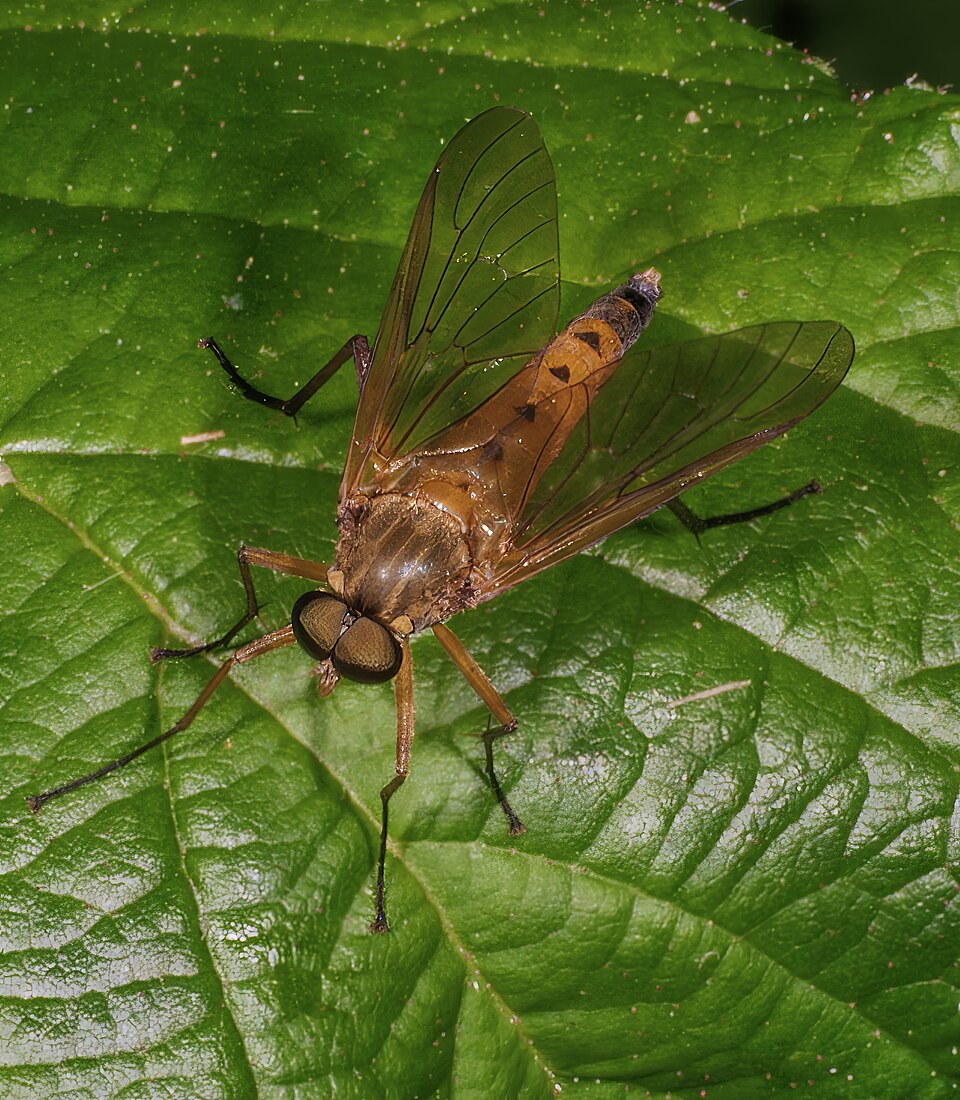
The marsh snipe fly is a slim fly with long, thin yellow orange legs. Its tummy is yellow orange with black triangles on top. It likes to sit still on leaves in wet meadows and woods.
Lives in
Most of Europe, and parts of northeastern and western North America, in wet meadows, hedges and woods
Length
0.8 to 1.4 cm (0.31 to 0.55 in)
Can it hurt you?
Harmless
Harmless to people.
What does it eat?
Its larvae live in the soil and hunt small beetles and earthworms.
How big is it?
How long is it?
🍚as long as 2.5 grains of rice in a row⚽could fly across a whole football pitch in 34 seconds⚡moves 220 times its own body length every second
How big is Marsh snipe fly compared to YOU?
Just maths in your browser. Nothing is saved or sent anywhere.
How fast is it?
A person walking about 5 km/h (3.1 mph)
Marsh snipe fly about 11 km/h (6.8 mph)
A kid running fast about 13 km/h (8.1 mph)
A grown-up on a bike about 25 km/h (16 mph)
cool stuff
Fun facts
1
Its babies live on the ground among fallen leaves and hunt there.
2
Its wings are clear, without the dark spot most of its cousins have.
3
The grown-up flies can be seen from May to September, resting on leaves.
you asked
Most asked questions about Marsh snipe fly
?Is the marsh snipe fly dangerous?
No. It is harmless to people.
?What does the marsh snipe fly eat?
Its larvae hunt small beetles and earthworms in the soil.
For bug experts
- Scientific name
- Rhagio tringarius
- Group
- Flies and mosquitoes
- Family
- Rhagionidae
- Classification
- Insecta > Diptera > Rhagionidae
- Lives on
- Europe, North America
- Also known as
- Marsh snipefly
Where the facts come from
- Rhagio tringarius (Wikipedia, CC BY-SA 4.0): what it looks like, where it lives, what it eats, sizes and fun facts, retold in simple words.
- Picture by Didier Descouens. CC BY-SA 4.0, Wikimedia Commons. The sticker of this bug is drawn from this picture.
If we got something wrong, sorry, we are bug fans, not a science journal. Tell us at [email protected] and we will fix it.
Bug Wiki honey jar For grown-ups: Bug Wiki is free, with no ads and no tracking. A small tip helps keep it online.Leave a tip Housefly
 New World screwworm fly
 Lovebug
 Tsetse fly
 Common fruit fly
 Asian tiger mosquito
 Florida leaf-footed bug
 African black beetle
 Apollo butterfly
 Christmas spider
 Ruby tiger
 Dogbane beetle
_Rhagio_tringarius_-_dorsal_view.jpg)