
Northern crescent
Phyciodes cocyta

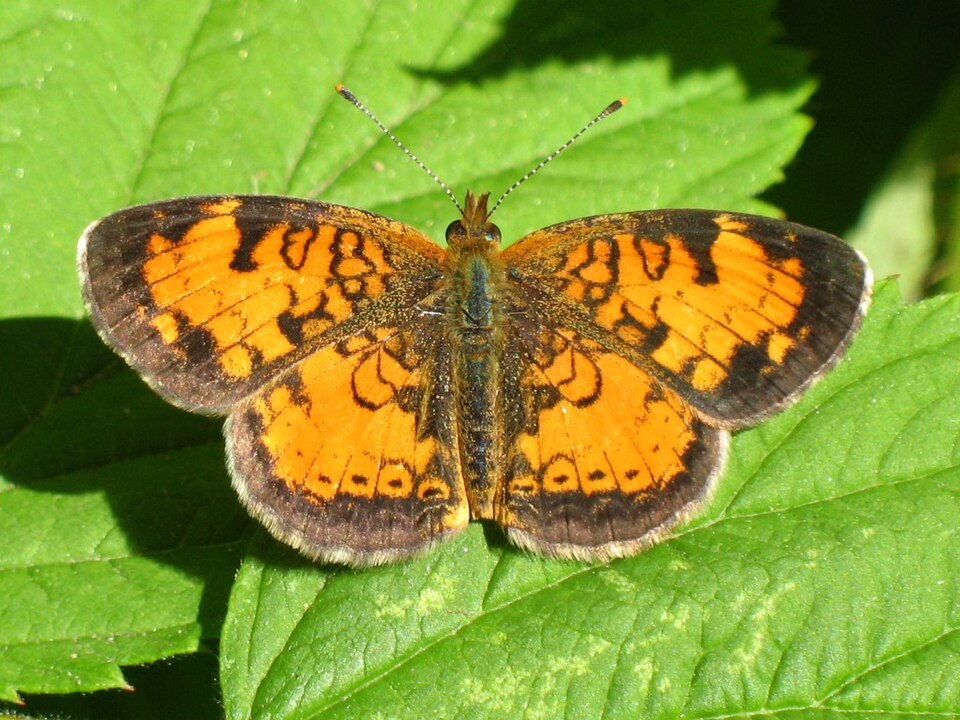
The northern crescent is a small orange and black butterfly from North America. It flutters over fields, meadows and sunny clearings in the woods in early summer.
Lives in
North America, in fields, meadows and woodland clearings
Wingspan
3.2 to 3.8 cm (1.3 to 1.5 in)
Can it hurt you?
Harmless
Harmless. It cannot bite or sting.
What does it eat?
The butterfly drinks nectar from flowers like dogbane, fleabane and white clover. Its caterpillar eats plants of the daisy family.
How big is it?
How wide are its wings?
🍚wings as wide as 6 grains of rice in a row⚽could fly across a whole football pitch in 32 seconds
How big is Northern crescent compared to YOU?
Just maths in your browser. Nothing is saved or sent anywhere.
How fast is it?
A person walking about 5 km/h (3.1 mph)
Northern crescent about 12 km/h (7.5 mph)
A kid running fast about 13 km/h (8.1 mph)
A grown-up on a bike about 25 km/h (16 mph)
cool stuff
Fun facts
1
It flies in June and July, depending on where it lives.
2
It looks a lot like two of its cousins, the tawny crescent and the pearl crescent.
3
White clover in a lawn is one of the flowers it likes to visit.
you asked
Most asked questions about Northern crescent
?What does the northern crescent eat?
The butterfly drinks nectar from flowers. The caterpillar eats daisy family plants.
?How big is the northern crescent?
Its wings measure about 3 to 4 centimetres from tip to tip.
For bug experts
- Scientific name
- Phyciodes cocyta
- Group
- Butterflies
- Family
- Nymphalidae
- Classification
- Insecta > Lepidoptera > Nymphalidae
- Lives on
- North America
Where the facts come from
- Phyciodes cocyta (Wikipedia, CC BY-SA 4.0): what it looks like, where it lives, what it eats, sizes and fun facts, retold in simple words.
- Picture by Gilles Gonthier. CC BY 2.0, Wikimedia Commons. The sticker of this bug is drawn from this picture.
If we got something wrong, sorry, we are bug fans, not a science journal. Tell us at [email protected] and we will fix it.
Bug Wiki honey jar For grown-ups: Bug Wiki is free, with no ads and no tracking. A small tip helps keep it online.Leave a tip Monarch butterfly
 Peacock butterfly
 Blue morpho
 Old World swallowtail
 Small white
 Eastern tiger swallowtail
 Large tree-cricket
 Orange virbia moth
 Slender green-winged grasshopper
 Rufous-legged grasshopper
 The clay
 Lupine aphid