
Plain hedge blue
Celastrina lavendularis

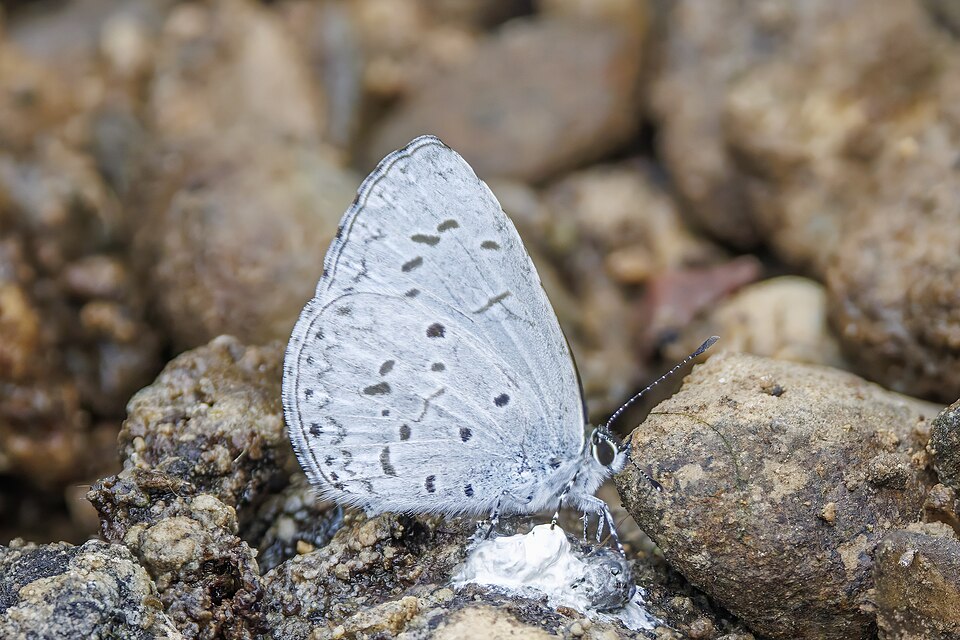
The plain hedge blue is a small butterfly. The male is a soft lavender blue on top, with a very thin black edge. Underneath, its wings are greyish white with little black spots.
Lives in
Sri Lanka, India and Southeast Asia to New Guinea
Can it hurt you?
Harmless
Harmless. It does not bite or sting.
What does it eat?
Like other butterflies, it drinks sweet nectar from flowers through a long tongue.
How fast is it?
A person walking about 5 km/h (3.1 mph)
A kid running fast about 13 km/h (8.1 mph)
Plain hedge blue about 15 km/h (9.3 mph)
A grown-up on a bike about 25 km/h (16 mph)
cool stuff
Fun facts
1
The female is paler and more purple, with black bands on her wings.
2
Scientists count twelve different kinds of it, living from Taiwan and the Philippines to Papua New Guinea.
3
It was first named in 1877, from a butterfly found in Sri Lanka.
you asked
Most asked questions about Plain hedge blue
?Where does the plain hedge blue live?
In Sri Lanka, India and Southeast Asia, and on islands as far as New Guinea.
?Is the plain hedge blue dangerous?
No. It is a small butterfly that cannot bite or sting.
For bug experts
- Scientific name
- Celastrina lavendularis
- Named by
- Moore, 1877
- Group
- Butterflies
- Family
- Lycaenidae
- Classification
- Insecta > Lepidoptera > Lycaenidae
- Lives on
- Asia, Australia and Oceania
Where the facts come from
- Celastrina lavendularis (Wikipedia, CC BY-SA 4.0): what it looks like, where it lives, what it eats, sizes and fun facts, retold in simple words.
- Picture by Charles J. Sharp. CC BY-SA 4.0, Wikimedia Commons. The sticker of this bug is drawn from this picture.
If we got something wrong, sorry, we are bug fans, not a science journal. Tell us at [email protected] and we will fix it.
Bug Wiki honey jar For grown-ups: Bug Wiki is free, with no ads and no tracking. A small tip helps keep it online.Leave a tip Monarch butterfly
 Peacock butterfly
 Blue morpho
 Old World swallowtail
 Small white
 Eastern tiger swallowtail
 Rimose fungus-farming ant
 Black-clothed bumble bee
 Black slender ant
 Six-spotted carpenter ant
 Big-bellied tylorida
 Iridescent semi-slug
_underside_Tad_Thong.jpg)