
Grass eggar
Lasiocampa trifolii

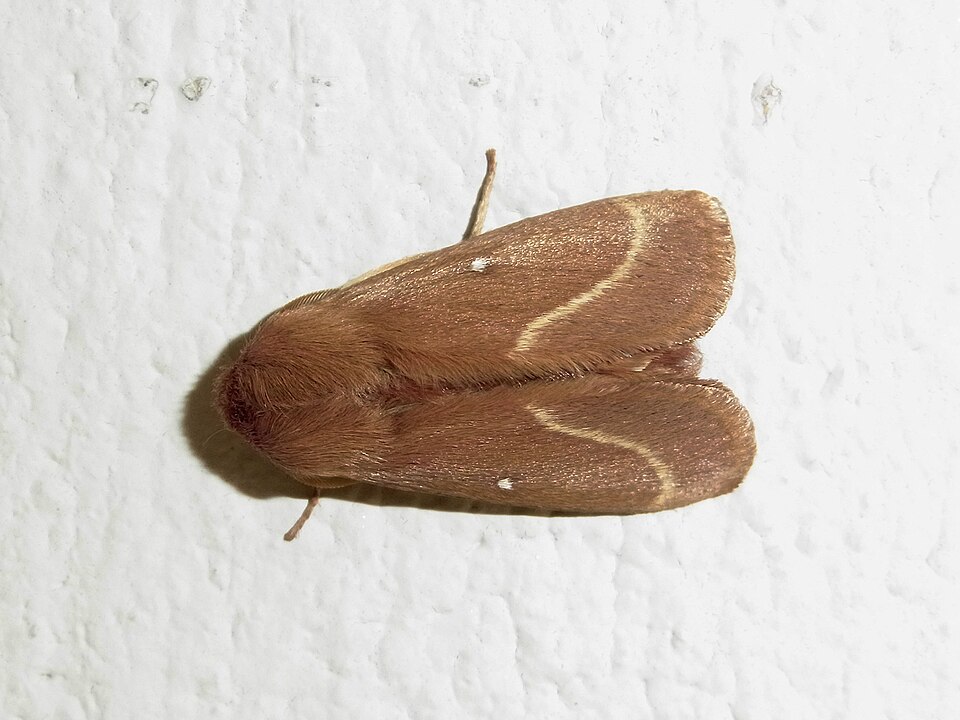
The grass eggar is a big, furry moth that lives in the sand dunes along European coasts. It flies by day and also at night. The female is bigger than the male.
Lives in
Europe, in sand dunes by the sea
Wingspan
4 to 5.5 cm (1.6 to 2.2 in)
Can it hurt you?
Harmless
Harmless. It does not bite or sting.
What does it eat?
Its caterpillars eat grasses, shrubs and leaves of trees such as oak, beech and poplar, and also heather.
How big is it?
How wide are its wings?
🧱wings as wide as 1.5 toy building bricks⚽could fly across a whole football pitch in 24 seconds
How big is Grass eggar compared to YOU?
Just maths in your browser. Nothing is saved or sent anywhere.
How fast is it?
A kid running fast about 13 km/h (8.1 mph)
Grass eggar about 16 km/h (9.9 mph)
A grown-up on a bike about 25 km/h (16 mph)
A car driving in town about 50 km/h (31 mph)
cool stuff
Fun facts
1
Its eggs are laid on leaves close to the ground and hatch in the autumn.
2
The young caterpillars sleep through the winter and keep growing in spring.
3
The caterpillar spins its cocoon down on the ground.
4
At night the moths are drawn to lights.
you asked
Most asked questions about Grass eggar
?Where does the grass eggar live?
In Europe, mostly in sand dunes along the coast.
?What does the grass eggar caterpillar eat?
Grasses, shrubs, heather and leaves of trees like oak and beech.
For bug experts
- Scientific name
- Lasiocampa trifolii
- Named by
- Denis & Schiffermüller, 1775
- Group
- Moths
- Family
- Lasiocampidae
- Classification
- Insecta > Lepidoptera > Lasiocampidae
- Lives on
- Europe
Where the facts come from
- Lasiocampa trifolii (Wikipedia, CC BY-SA 4.0): what it looks like, where it lives, what it eats, sizes and fun facts, retold in simple words.
- Picture by Donkey shot. CC BY-SA 3.0, Wikimedia Commons. The sticker of this bug is drawn from this picture.
If we got something wrong, sorry, we are bug fans, not a science journal. Tell us at [email protected] and we will fix it.
Bug Wiki honey jar For grown-ups: Bug Wiki is free, with no ads and no tracking. A small tip helps keep it online.Leave a tip Atlas moth
 Luna moth
 Hummingbird hawk-moth
 Domestic silk moth
 Isabella tiger moth
 Polyphemus moth
 Pale dun
 Long skimmer
 Portia widow
 Small red sedge
 Formosan jewelwing
 Willow apple gall sawfly