
Oriental latrine fly
Chrysomya megacephala

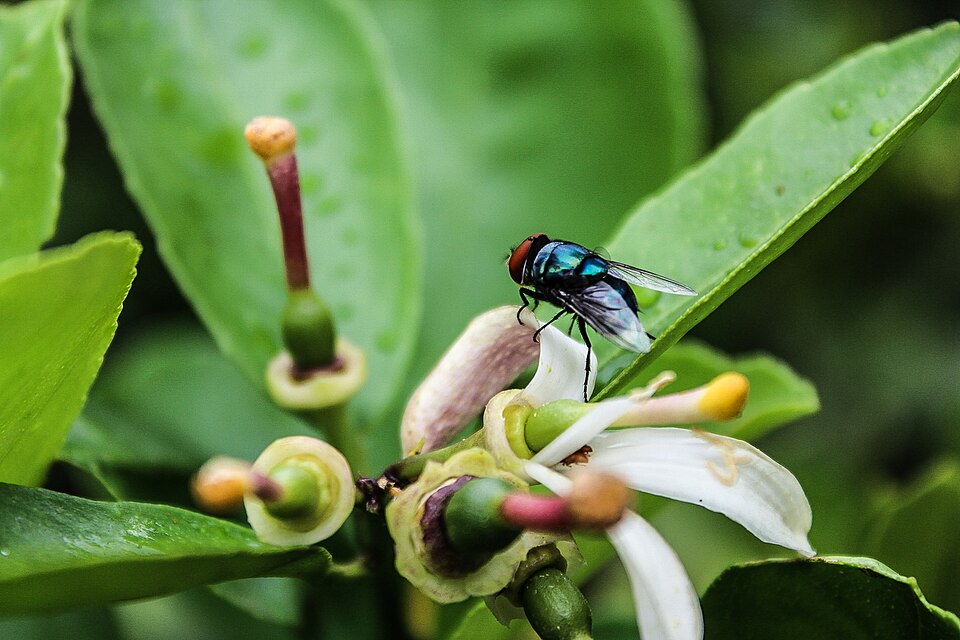
The oriental latrine fly is a shiny blowfly with a metallic blue-green body, like a little jewel. It has big red eyes and yellow cheeks. It loves warm weather and often lives close to people.
Lives in
First from tropical Asia and Australasia, now spread to Africa and the Americas too
Can it hurt you?
Dangerous: look, do not touch
It does not bite or sting, but it can spread germs and its maggots can make people and animals sick. Keep food covered, do not touch it, and tell a grown-up if there are many flies.
What does it eat?
It feeds on rotting things like old meat, fish and dung. The mother lays her eggs there so her maggots have food.
How fast is it?
A person walking about 5 km/h (3.1 mph)
Oriental latrine fly about 8 km/h (5 mph)
A kid running fast about 13 km/h (8.1 mph)
A grown-up on a bike about 25 km/h (16 mph)
cool stuff
Fun facts
1
A mother can lay 200 to 300 eggs at a time.
2
In warm weather it can grow from egg to grown-up fly in about 10 days.
3
The male's big red eyes almost touch each other. The female's eyes are farther apart.
4
It has spread to new countries by hitching rides through harbours and airports.
5
The boys usually come out of their pupae two or three hours before the girls.
you asked
Most asked questions about Oriental latrine fly
?What does the oriental latrine fly eat?
Rotting meat and fish, dung and other decaying things.
For bug experts
- Scientific name
- Chrysomya megacephala
- Group
- Flies and mosquitoes
- Family
- Calliphoridae
- Classification
- Insecta > Diptera > Calliphoridae
- Lives on
- Asia, Australia and Oceania, Africa, North America, South America
- Also known as
- Oriental blue fly
Where the facts come from
- Chrysomya megacephala (Wikipedia, CC BY-SA 4.0): what it looks like, where it lives, what it eats, sizes and fun facts, retold in simple words.
- Picture by Teguh Fitrayasha. CC BY-SA 4.0, Wikimedia Commons. The sticker of this bug is drawn from this picture.
If we got something wrong, sorry, we are bug fans, not a science journal. Tell us at [email protected] and we will fix it.
Bug Wiki honey jar For grown-ups: Bug Wiki is free, with no ads and no tracking. A small tip helps keep it online.Leave a tip Housefly
 New World screwworm fly
 Lovebug
 Tsetse fly
 Common fruit fly
 Asian tiger mosquito
 Black and yellow mud dauber
 Cigarette beetle
 Chilean recluse
 Cat flea
 Grey silverfish
 Mediterranean recluse