
Pope Valley timema
Timema poppense

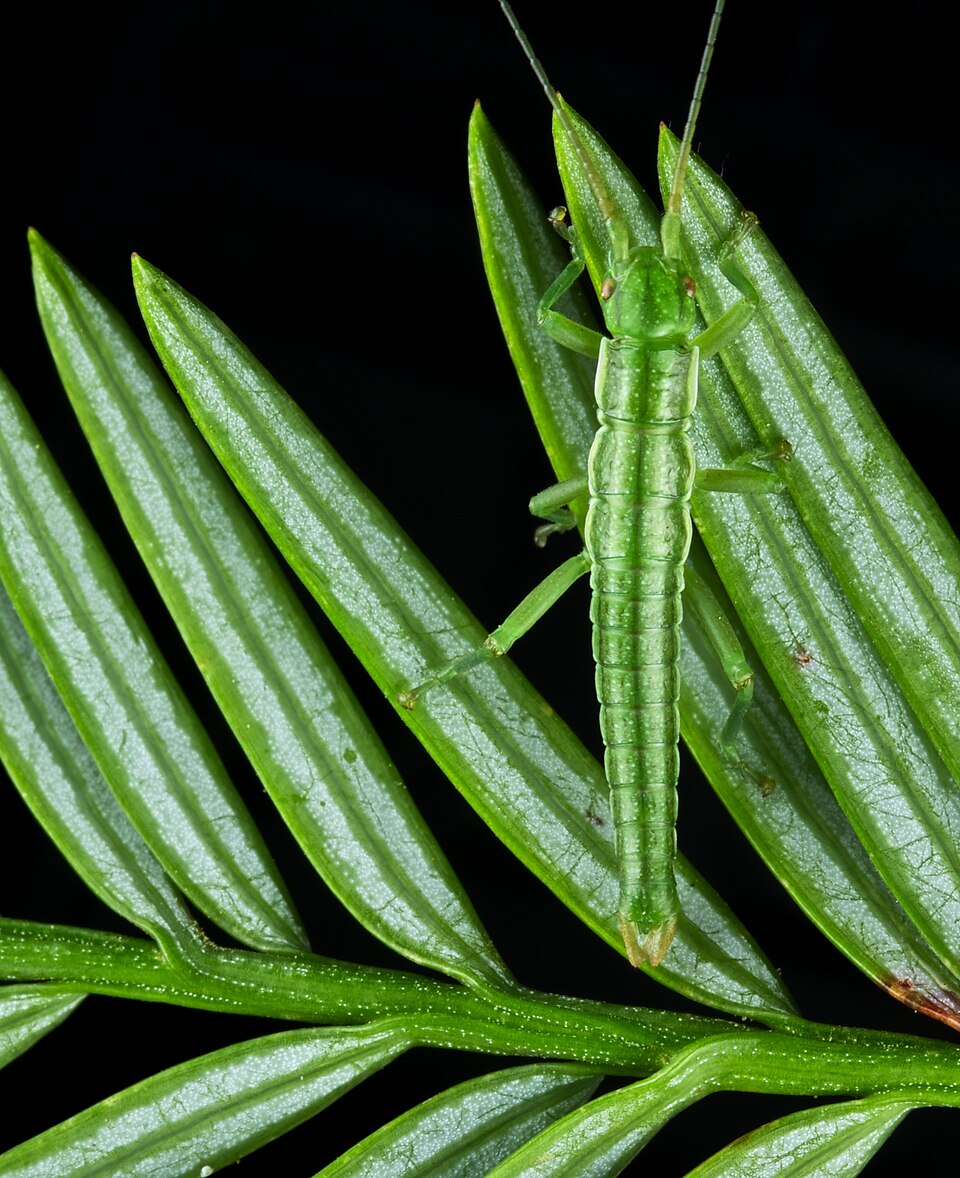
The Pope Valley timema is a little walking stick from California. Timemas are short and chunky compared with the long, twiggy stick insects most people know. It was first found in a nature reserve in the Pope Valley.
Lives in
California in the United States
Can it hurt you?
Harmless
Harmless. It has no sting and does not bite people.
What does it eat?
Like other walking sticks, it eats the leaves of plants.
How fast is it?
A garden snail about 0.05 km/h (0.03 mph)
Pope Valley timema about 0.2 km/h (0.12 mph)
A tortoise about 0.3 km/h (0.19 mph)
A person walking about 5 km/h (3.1 mph)
cool stuff
Fun facts
1
Its scientific name was first spelled poppensis, but it had to be changed to poppense to follow the grammar rules for animal names.
2
Timemas have no wings at all.
3
It is named after the Pope Valley in California, where scientists first described it.
you asked
Most asked questions about Pope Valley timema
?Is the Pope Valley timema dangerous?
No. It is a small, harmless plant eater.
?Where does the Pope Valley timema live?
In California, and it was first found in a nature reserve in the Pope Valley.
For bug experts
- Scientific name
- Timema poppense
- Group
- Stick and leaf insects
- Family
- Timematidae
- Classification
- Insecta > Phasmatodea > Timematidae
- Lives on
- North America
Where the facts come from
- Timema poppense (Wikipedia, CC BY-SA 4.0): what it looks like, where it lives, what it eats, sizes and fun facts, retold in simple words.
- Picture by Moritz Muschick (University of Sheffield). CC BY 2.0, Wikimedia Commons. The sticker of this bug is drawn from this picture.
If we got something wrong, sorry, we are bug fans, not a science journal. Tell us at [email protected] and we will fix it.
Bug Wiki honey jar For grown-ups: Bug Wiki is free, with no ads and no tracking. A small tip helps keep it online.Leave a tip Lord Howe Island stick insect
 Giant prickly stick insect
 Common walkingstick
 Two-striped walkingstick
 Indian stick insect
 Goliath stick insect
 Omnivorous looper
 Little 17-year cicada
 Robust oak borer
 Clouded border
 Mournful duskywing
 Hologram moth
,_California.jpg)