
Stripe-legged robber fly
Dioctria hyalipennis

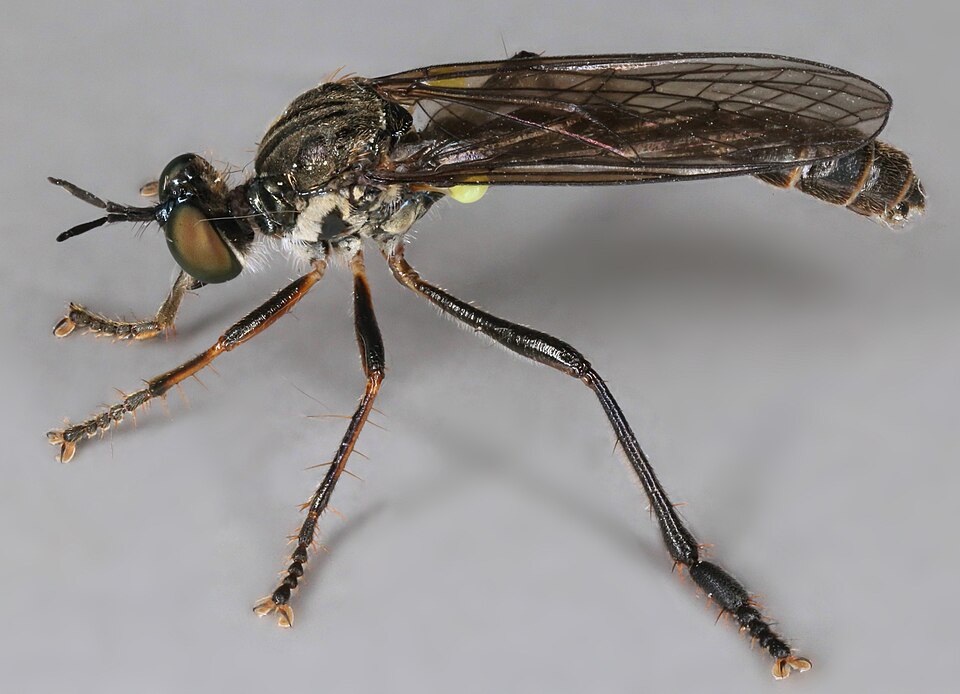
The stripe-legged robber fly is a slim, shiny black fly with a humped back. Its front and middle legs are yellow with black streaks. It is a quick little hunter that catches other insects.
Lives in
Europe, northern Asia and North America, in meadows, hedges and forest edges
Length
1 to 1.4 cm (0.39 to 0.55 in)
Can it hurt you?
Harmless
Harmless to people. It is a small fly that hunts other insects.
What does it eat?
It mostly catches small wasps and bees, and sometimes small flies and tiny grasshoppers.
How big is it?
How long is it?
🍚as long as 2.5 grains of rice in a row⚽could fly across a whole football pitch in 34 seconds⚡moves 220 times its own body length every second
How big is Stripe-legged robber fly compared to YOU?
Just maths in your browser. Nothing is saved or sent anywhere.
How fast is it?
A person walking about 5 km/h (3.1 mph)
Stripe-legged robber fly about 11 km/h (6.8 mph)
A kid running fast about 13 km/h (8.1 mph)
A grown-up on a bike about 25 km/h (16 mph)
cool stuff
Fun facts
1
Its face has a silvery white beard of hair.
2
Its back legs are black with a fat first foot segment.
3
It flies from May to July.
4
It is very hard to tell apart from its close cousins.
you asked
Most asked questions about Stripe-legged robber fly
?What does the stripe-legged robber fly eat?
It catches small wasps, bees, flies and pygmy grasshoppers.
?Is the stripe-legged robber fly dangerous?
No. It is harmless to people.
For bug experts
- Scientific name
- Dioctria hyalipennis
- Named by
- Fabricius, 1794
- Group
- Flies and mosquitoes
- Family
- Asilidae
- Classification
- Insecta > Diptera > Asilidae
- Lives on
- Europe, Asia, North America
Where the facts come from
- Dioctria hyalipennis (Wikipedia, CC BY-SA 4.0): what it looks like, where it lives, what it eats, sizes and fun facts, retold in simple words.
- Picture by janet graham. CC BY 2.0, Wikimedia Commons. The sticker of this bug is drawn from this picture.
If we got something wrong, sorry, we are bug fans, not a science journal. Tell us at [email protected] and we will fix it.
Bug Wiki honey jar For grown-ups: Bug Wiki is free, with no ads and no tracking. A small tip helps keep it online.Leave a tip Housefly
 New World screwworm fly
 Lovebug
 Tsetse fly
 Common fruit fly
 Asian tiger mosquito
 Vagabond sod webworm moth
 Desert cricket
 Mary's odorous ant
 Common chrysalis-snail
 Milky flower spider
 Enamelled spider
.jpg)