
Hyatt's big-headed ant
Pheidole hyatti

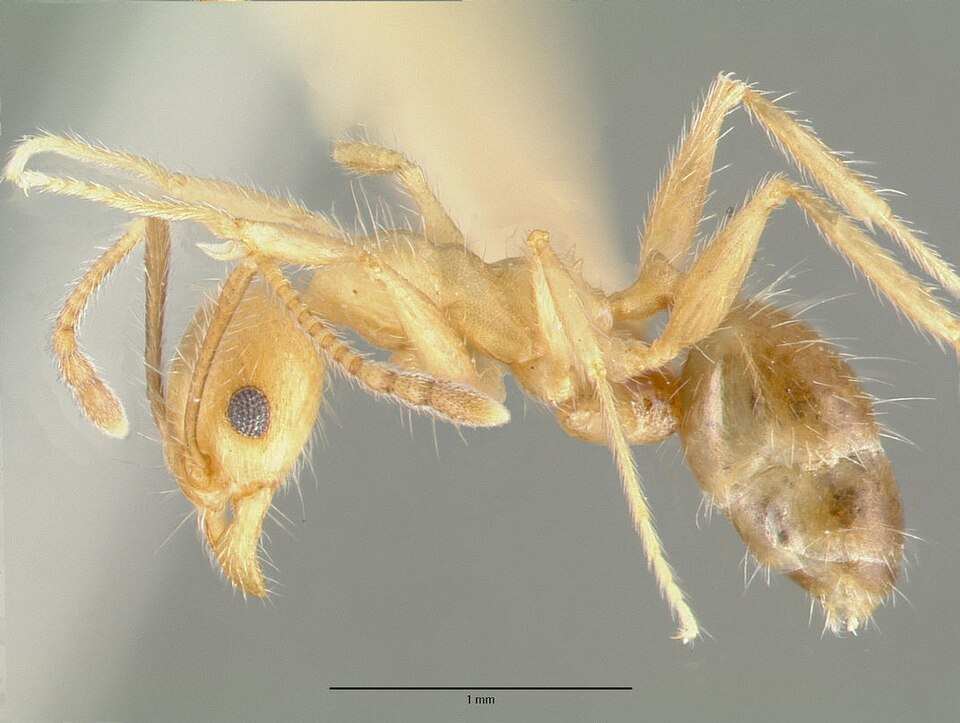
Hyatt's big-headed ant is a small ant from the south-western United States, Mexico and Guatemala. Big-headed ants are named after their soldiers, which have huge heads compared with their bodies. It lives in a busy colony, like all ants.
Lives in
The south-western United States, Mexico and Guatemala. People also carried it to Hawaii
What does it eat?
Like most ants, it eats a mix of small insects, seeds and sweet things.
How fast is it?
A garden snail about 0.05 km/h (0.03 mph)
A tortoise about 0.3 km/h (0.19 mph)
Hyatt's big-headed ant about 0.3 km/h (0.19 mph)
A person walking about 5 km/h (3.1 mph)
cool stuff
Fun facts
1
Its colony has small workers and big-headed soldiers with strong jaws.
2
It has spread to Hawaii, where it does not belong.
3
It may also live in Panama, Bolivia and Argentina, but scientists are not sure yet.
you asked
Most asked questions about Hyatt's big-headed ant
?Why is it called a big-headed ant?
Because the soldier ants in its colony have very big heads with strong jaws.
?Where does Hyatt's big-headed ant live?
In the south-western United States, Mexico and Guatemala, and it has spread to Hawaii.
For bug experts
- Scientific name
- Pheidole hyatti
- Named by
- Emery, 1895
- Group
- Ants
- Family
- Formicidae
- Classification
- Insecta > Hymenoptera > Formicidae
- Lives on
- North America, Australia and Oceania
Where the facts come from
- Pheidole hyatti (Wikipedia, CC BY-SA 4.0): what it looks like, where it lives, what it eats, sizes and fun facts, retold in simple words.
- Picture by AntWeb.org. CC BY 4.0, Wikimedia Commons. The sticker of this bug is drawn from this picture.
If we got something wrong, sorry, we are bug fans, not a science journal. Tell us at [email protected] and we will fix it.
Bug Wiki honey jar For grown-ups: Bug Wiki is free, with no ads and no tracking. A small tip helps keep it online.Leave a tip Black garden ant
 Bullet ant
 Pharaoh ant
 Argentine ant
 Red imported fire ant
 Yellow crazy ant
 Urbane digger bee
 Leaf-curling spider
 Ivy bee
 American snout
 Mediterranean hyalomma
 Gulf Coast tick