
Yellow-banded polybia wasp
Polybia occidentalis

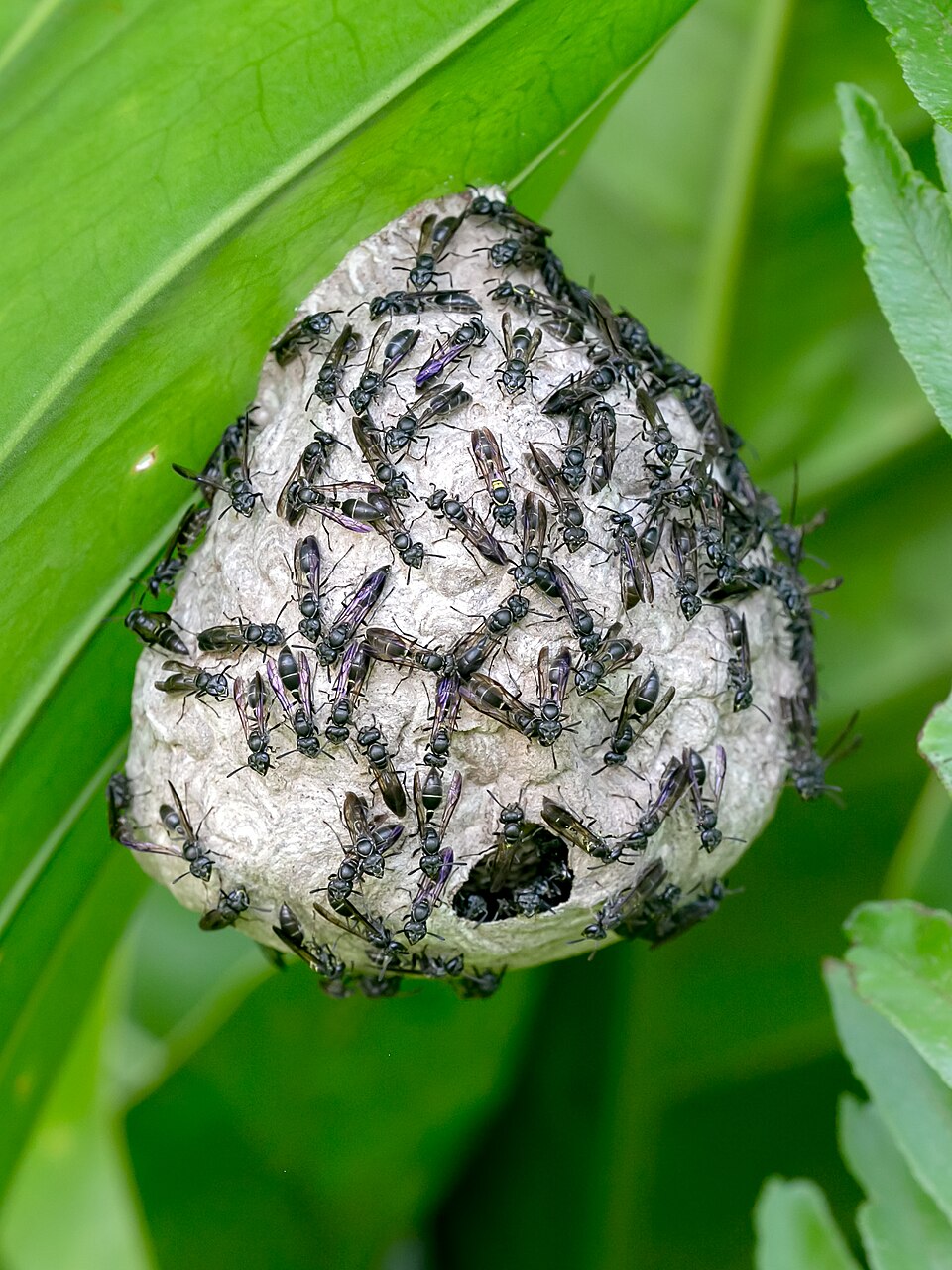
The yellow-banded polybia wasp is a small black wasp with a few yellow stripes on its tail end. It lives in big families that build a teardrop shaped paper nest together. The nest hangs in bushes, trees or even on buildings.
Lives in
Mexico, Central America and South America to northern Argentina, in tropical forests and pastures
What does it eat?
It eats nectar and other sweet things, and hunts insects.
How fast is it?
A kid running fast about 13 km/h (8.1 mph)
Yellow-banded polybia wasp about 22 km/h (14 mph)
A grown-up on a bike about 25 km/h (16 mph)
A car driving in town about 50 km/h (31 mph)
cool stuff
Fun facts
1
A whole swarm of wasps finds a nest place and builds the nest together.
2
Its nest is 10 to 25 centimetres long and has two to eight floors of combs inside.
3
The nest is made of chewed wood mixed with water, and it is built from the top down.
4
They like to build nests in the morning.
you asked
Most asked questions about Yellow-banded polybia wasp
?What does the yellow-banded polybia wasp nest look like?
It is a teardrop shaped paper nest, 10 to 25 centimetres long, hanging in a bush or tree.
For bug experts
- Scientific name
- Polybia occidentalis
- Group
- Wasps and hornets
- Family
- Vespidae
- Classification
- Insecta > Hymenoptera > Vespidae
- Lives on
- North America, South America
- Also known as
- Camoati
Where the facts come from
- Polybia occidentalis (Wikipedia, CC BY-SA 4.0): what it looks like, where it lives, what it eats, sizes and fun facts, retold in simple words.
- Picture by Charlie Jackson. CC BY 2.0, Wikimedia Commons. The sticker of this bug is drawn from this picture.
If we got something wrong, sorry, we are bug fans, not a science journal. Tell us at [email protected] and we will fix it.
Bug Wiki honey jar For grown-ups: Bug Wiki is free, with no ads and no tracking. A small tip helps keep it online.Leave a tip European hornet
 Northern giant hornet
 Bald-faced hornet
 Red velvet ant
 Eastern cicada killer
 Asian hornet
 Giant northern termite
 Red-and-black flatwing
 Mournful sphinx
 African giant centipede
 Common jay
 Emerald green snail
.jpg)