
Asian blood tail
Lathrecista asiatica

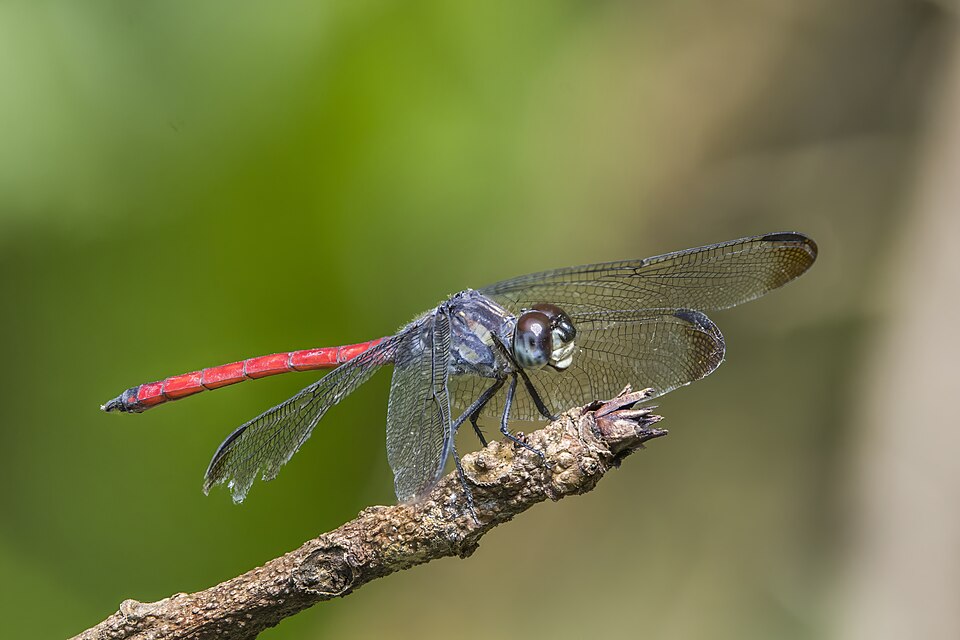
The Asian blood tail is a dragonfly with a bright blood red tail and grey eyes with brown caps. Its body has two thin yellow stripes on the back. The girls have a brown tail instead of a red one.
Lives in
From India to Australia, near ponds, streams and marshes
Can it hurt you?
Harmless
Harmless. Dragonflies do not sting people.
What does it eat?
Like all dragonflies, it catches other small insects. Its babies hunt under water.
How fast is it?
A kid running fast about 13 km/h (8.1 mph)
A grown-up on a bike about 25 km/h (16 mph)
Asian blood tail about 40 km/h (25 mph)
A car driving in town about 50 km/h (31 mph)
cool stuff
Fun facts
1
It is the only species in its group, so it has no close sisters.
2
Its name Lathrecista means hidden basket. It refers to the tiny, hard to see parts at the end of the male's tail.
3
The very end of its red tail is black.
4
The first ones scientists studied were collected in India.
you asked
Most asked questions about Asian blood tail
?Is the Asian blood tail dangerous?
No. Dragonflies cannot sting and are harmless to people.
?Where does the Asian blood tail live?
From India to Australia, in marshes near ponds and streams.
For bug experts
- Scientific name
- Lathrecista asiatica
- Group
- Dragonflies and damselflies
- Family
- Libellulidae
- Classification
- Insecta > Odonata > Libellulidae
- Lives on
- Asia, Australia and Oceania
- Also known as
- Asiatic blood tail
Where the facts come from
- Lathrecista asiatica (Wikipedia, CC BY-SA 4.0): what it looks like, where it lives, what it eats, sizes and fun facts, retold in simple words.
- Picture by Charles J. Sharp. CC BY-SA 4.0, Wikimedia Commons. The sticker of this bug is drawn from this picture.
If we got something wrong, sorry, we are bug fans, not a science journal. Tell us at [email protected] and we will fix it.
Bug Wiki honey jar For grown-ups: Bug Wiki is free, with no ads and no tracking. A small tip helps keep it online.Leave a tip Emperor dragonfly
 Common whitetail
 Green darner
 Ebony jewelwing
 Globe skimmer
 Blue dasher
 Medicinal leech
 Giant water bug
 Yellow fly of the Dismal Swamp
 Wetland giant wolf spider
 Sea slater
 Ringed paper wasp
_male_Viti_Levu.jpg)