
Mango longhorn beetle
Batocera rubus

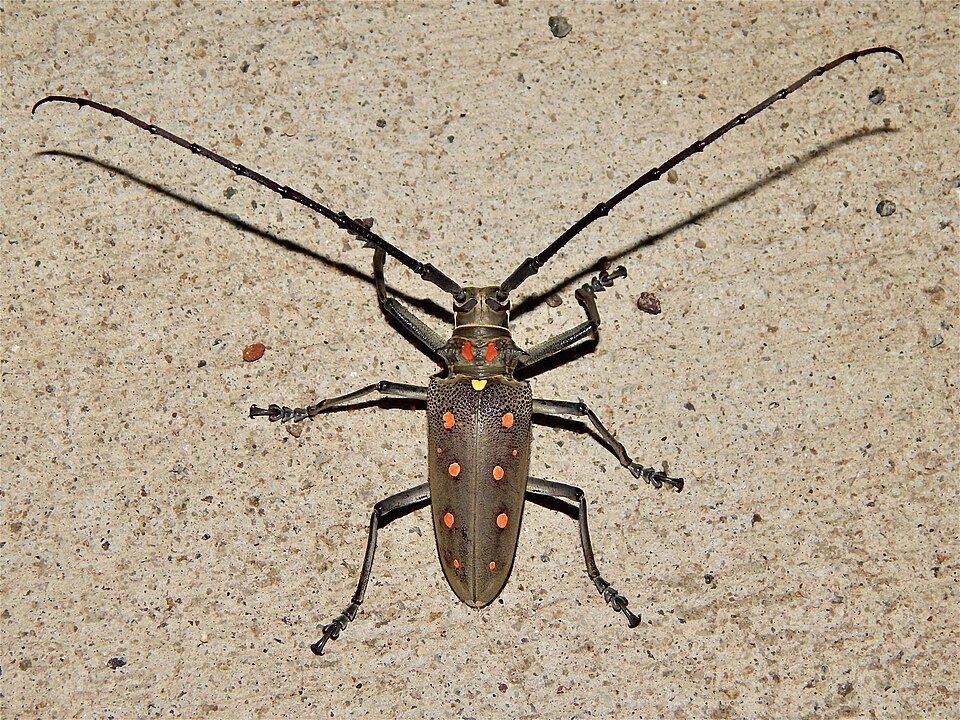
The mango longhorn is a big beetle with very long feelers. It can grow as long as a grown up's finger. It lives in warm parts of Asia and feeds on mango and fig trees.
Lives in
Asia, from Japan and China to India, Java and the Philippines
Length
2 to 6.5 cm (0.79 to 2.6 in)
Can it hurt you?
Harmless
Not dangerous. Big beetles can pinch, so look but do not grab it.
What does it eat?
It feeds on mango trees, fig trees and rubber fig trees.
How big is it?
How long is it?
🧱as long as 2 toy building bricks in a row🍽️could run across a dinner table in 5.6 seconds
How big is Mango longhorn beetle compared to YOU?
Just maths in your browser. Nothing is saved or sent anywhere.
How fast is it?
A garden snail about 0.05 km/h (0.03 mph)
A tortoise about 0.3 km/h (0.19 mph)
Mango longhorn beetle about 0.64 km/h (0.4 mph)
A person walking about 5 km/h (3.1 mph)
cool stuff
Fun facts
1
It can be anywhere from 2 to 6.5 centimetres long.
2
It was named in 1758 by Carl Linnaeus, the scientist who started giving animals their scientific names.
3
Its other name is the rubber root borer.
you asked
Most asked questions about Mango longhorn beetle
?How big is the mango longhorn beetle?
Big, about 20 to 65 millimetres long, plus its long feelers.
?What does the mango longhorn beetle eat?
It feeds on mango trees, fig trees and rubber fig trees.
For bug experts
- Scientific name
- Batocera rubus
- Named by
- Linnaeus, 1758
- Group
- Beetles
- Family
- Cerambycidae
- Classification
- Insecta > Coleoptera > Cerambycidae
- Lives on
- Asia
- Also known as
- Rubber root borer
Where the facts come from
- Batocera rubus (Wikipedia, CC BY-SA 4.0): what it looks like, where it lives, what it eats, sizes and fun facts, retold in simple words.
- Picture by Gouthamching. CC BY-SA 4.0, Wikimedia Commons. The sticker of this bug is drawn from this picture.
If we got something wrong, sorry, we are bug fans, not a science journal. Tell us at [email protected] and we will fix it.
Bug Wiki honey jar For grown-ups: Bug Wiki is free, with no ads and no tracking. A small tip helps keep it online.Leave a tip Stag beetle
 Hercules beetle
 Common glow-worm
 Goliath beetle
 Cockchafer
 Mealworm beetle
 Brazilian robust-stingless bee
 Sara longwing
 Dirce beauty
 Grizzled pinktoe tarantula
 Cream-spotted tigerwing
 Ornamental tree trunk spider