
Marsh bluet

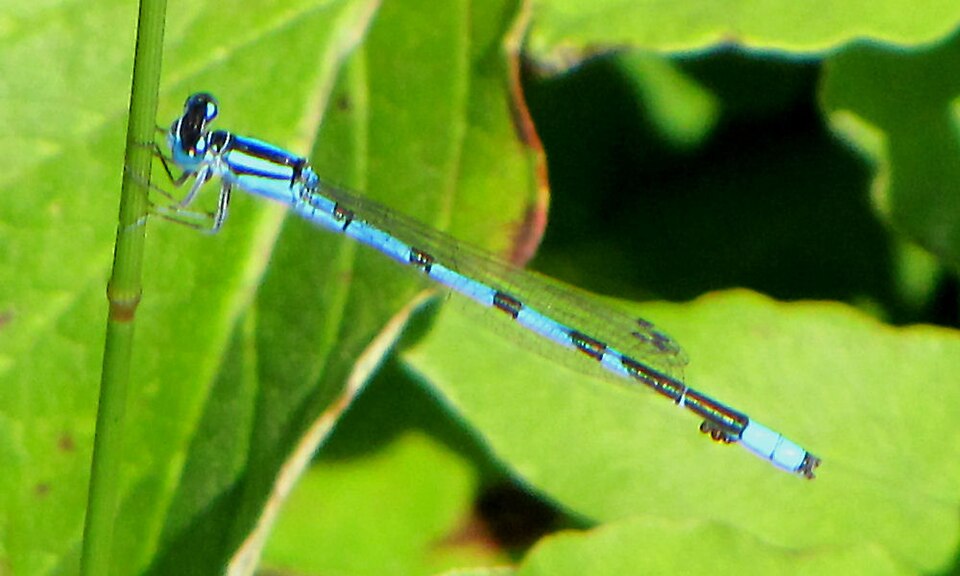
The marsh bluet is a small, thin damselfly. The male is bright blue with black stripes and has big dark eyes. The female is tan or blue-green with black. It flies slowly and darts in and out between water plants.
How big is it?
How long is it?
How big is Marsh bluet compared to YOU?
Just maths in your browser. Nothing is saved or sent anywhere.
How fast is it?
Fun facts
Its babies, called naiads, live under water and are only about 2 centimetres long.
To lay her eggs, the female can climb down as deep as about 30 centimetres under the water.
Males choose a good spot by the water and guard it as their own.
When it rests, it holds its wings together over its back.
It flies from early June to early September and can be very common at marshes in midsummer.
Most asked questions about Marsh bluet
?Is the marsh bluet dangerous?
No. It cannot sting and it does not bite people. It is a helper, because it eats mosquitoes.
?What does a marsh bluet eat?
Small flying insects like mosquitoes, flies and little moths. Its young eat mosquito larvae under water.
?How big is a marsh bluet?
About 2.5 to 3.4 centimetres long, a bit longer than a paper clip.
For bug experts
- Scientific name
- Enallagma ebrium
- Group
- Dragonflies and damselflies
- Family
- Coenagrionidae
- Classification
- Insecta > Odonata > Coenagrionidae
- Lives on
- North America
Where the facts come from
- Marsh bluet (Wikipedia, CC BY-SA 4.0): what it looks like, where it lives, what it eats, sizes and fun facts, retold in simple words.
- Picture by D. Gordon E. Robertson. CC BY-SA 3.0, Wikimedia Commons. The sticker of this bug is drawn from this picture.
If we got something wrong, sorry, we are bug fans, not a science journal. Tell us at [email protected] and we will fix it.
Bug Wiki honey jar For grown-ups: Bug Wiki is free, with no ads and no tracking. A small tip helps keep it online.Leave a tip Emperor dragonfly
 Common whitetail
 Green darner
 Ebony jewelwing
 Globe skimmer
 Blue dasher
 Small red sedge
 Willow apple gall sawfly
 Chevrolat's dytiscid
 Mulsant's water treader
 Marsh click beetle
 Small yellow sally