
Small emerald

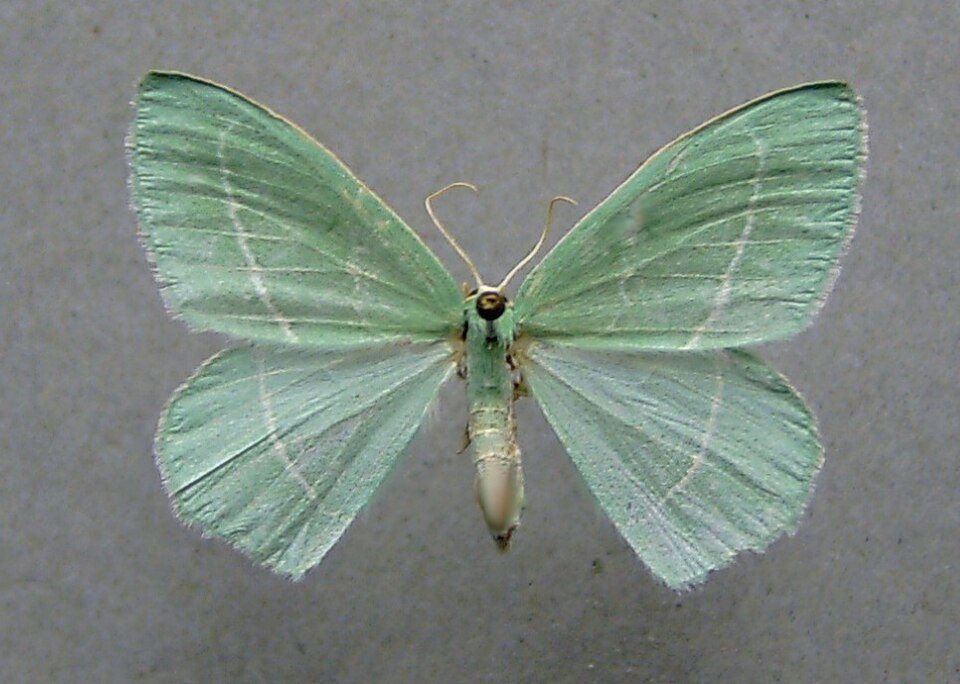
The small emerald is a moth with light green wings, like a fresh leaf. As it gets older, the green slowly fades to yellow green and then almost white. Thin white lines run across its wings.
How big is it?
How wide are its wings?
How big is Small emerald compared to YOU?
Just maths in your browser. Nothing is saved or sent anywhere.
How fast is it?
Fun facts
Its caterpillar changes colour with the seasons: green at first, brownish during winter and green again in spring.
Even its pupa is green.
Its eggs are green and very flat, and turn dark just before they hatch.
It likes warm slopes, wood edges, hedges, gardens and parks.
In Britain the moths fly once a year, from June to August.
Most asked questions about Small emerald
?What does the small emerald eat?
Its caterpillars eat the leaves of wild clematis.
?How big is the small emerald?
Its wings measure 28 to 32 millimetres from tip to tip.
For bug experts
- Scientific name
- Hemistola chrysoprasaria
- Group
- Moths
- Family
- Geometridae
- Classification
- Insecta > Lepidoptera > Geometridae
- Lives on
- Europe, Africa, Asia
Where the facts come from
- Hemistola chrysoprasaria (Wikipedia, CC BY-SA 4.0): what it looks like, where it lives, what it eats, sizes and fun facts, retold in simple words.
- Picture by Dumi. CC BY-SA 3.0, Wikimedia Commons. The sticker of this bug is drawn from this picture.
If we got something wrong, sorry, we are bug fans, not a science journal. Tell us at [email protected] and we will fix it.
Bug Wiki honey jar For grown-ups: Bug Wiki is free, with no ads and no tracking. A small tip helps keep it online.Leave a tip Atlas moth
 Luna moth
 Hummingbird hawk-moth
 Domestic silk moth
 Isabella tiger moth
 Polyphemus moth
 Western calligrapher
 Collared carpenter bee
 Milky flower spider
 Enamelled spider
 White-palped jumping spider
 Almond ringlet